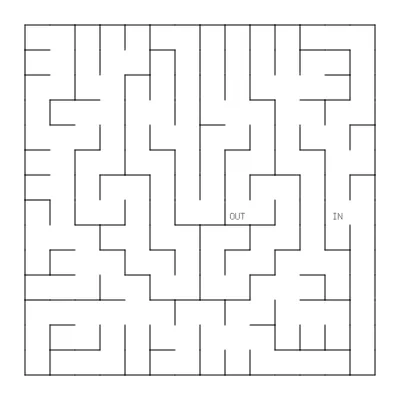
Maze
Mazev1.0.0Mazes on square, triangular, hexagonal and circular grids, carved by eleven algorithms, with answer keys.
Find the one path from entrance to exit.
What it is
A field of passages and walls with a marked entry and exit. In a perfect
maze there are no loops — exactly one route joins any two points. This crate
carves rectangular, hex and circular mazes, and masked shapes (a heart, an
animal silhouette) for kids’ pages; a braid knob melts dead-ends into
loops for a different texture.
How to play
Trace with a pencil, backing out of dead ends. On paper, wall-following (keep one hand on a wall) solves any perfect maze whose exit is on the boundary. Harder mazes are attacked from both ends at once — the two searches meet in the middle far faster than either alone.
Purpose
The kids-lane anchor and the most shape-flexible generator (any silhouette becomes a maze). It is also a texture study: the carving algorithm is itself a style parameter — Kruskal mazes feel porous and even, recursive-backtracker mazes feel like long winding corridors — and the spec exposes that choice.
History
Labyrinths are ancient — the Knossos myth, Roman mosaic labyrinths, turf mazes — but those were unicursal (one path, no choices). The puzzle maze with junctions arrives with Renaissance hedge mazes (Hampton Court, 1690s). Algorithmic generation is a 20th-century development: depth-first carving, Eller’s row-by-row method, Wilson’s loop-erased walks — all of which this crate implements.
This implementation
- Spec knobs:
topology(rect / hex / circular / masked),algorithm(recursive backtracker, Wilson’s, Kruskal, growing tree, Eller’s),braid, entry/exit placement,difficulty. - Generation: carve on the shared
lako-gridtopologies; masked shapes rasterise a silhouette onto the grid and carve inside it. - Guarantees: the maze is connected; at
braid = 0it is perfect (every pair of cells joined by exactly one path); the answer key overlays the BFS solution path as an aux scene. - Difficulty: solution-path length ratio, branching factor along the path, and dead-end depth distribution — measured on the carved maze, not assumed from the algorithm.
Weave mazes
Setting weave above zero carves a maze whose passages cross over and under
one another. Rectangular grids only, and it replaces the chosen carver: a hop
needs “the cell directly beyond” rather than bare adjacency, the same reason
Binary Tree and Eller’s are rectangle-only.
The construction is the interesting part. Adding a tunnel to a finished
maze would create a loop, because a finished maze is a spanning tree and
every pair of cells is already joined. So the tunnels are carved as part of
the tree: standing at a cell, the carver may dive under a visited
straight-through neighbour to claim the unvisited cell beyond it — one new
cell by one new edge, which is exactly what keeps the result perfect. A test
asserts it directly: cells - 1 edges, every cell reachable, at any density.
The graph needed no new shape. Passages is a general adjacency list, so a
tunnel is just the edge between two cells two apart, and the breadth-first
solver walks it without knowing it is unusual — which a test also checks, by
stepping the whole solution through passages.
The renderer did need new work, and the reason is worth stating: a wall-drawn maze cannot show a tunnel by omission the way a corridor-drawn one can. The walls between the tunnel’s ends and the cell it passes under are correctly solid — the tunnel does not enter that cell — so with nothing else drawn, a crossing is invisible and unsolvable. Each crossing is therefore drawn explicitly, in the order that reads: the tunnel’s side walls through the cell, then the over-corridor’s floor as a white band covering them, then the over-corridor’s walls redrawn on top.
Braiding is skipped under a weave, and the metadata says so — adding loops
afterwards would undo the property the hop construction exists to preserve.
The algorithm field reports Weave rather than the carver that went
unused.