Akari (Light Up)
Logic puzzlev1.0.0Place bulbs to light every cell, with no two bulbs shining on each other.
Place light bulbs in white cells so every cell is lit and no two bulbs shine on each other.
What it is
A grid of white and black cells. Some black cells carry a number: exactly that many bulbs must sit in the (up to four) white cells beside it. A bulb lights every cell in its row and column until a black cell blocks the beam. The goal: every white cell lit, and no bulb in another bulb’s beam.
How to play
Start at the numbers. A “4” forces bulbs on all four sides; a “0” forbids all four. A numbered cell whose remaining free neighbours exactly match its count forces them all. Cells that no candidate bulb can reach must themselves hold a bulb. Mark cells that cannot hold a bulb (lit cells, and neighbours of a satisfied number) — the answer falls out of the interaction.
Purpose
A gentle, visual entry into constraint puzzles — beams are easy to see, and the “no two bulbs see each other” rule reads instantly. In the workspace it is also the crate that showed a whole generator can work without search: placing bulbs greedily and lighting everything is a loop that cannot fail.
History
Introduced by Nikoli in 2001 as Bijutsukan (“art gallery”), published in English as Akari or Light Up. It descends from the mathematical art-gallery illumination problems, turned into a pencil puzzle with the beam-blocking twist.
This implementation
- Spec knobs:
rows,cols,wall_share,numbered_share,difficulty. - Generation: answer first — walls are scattered, bulbs are placed by a greedy pass that provably lights everything, numbers are read off the walls, and numbers are thinned while the board keeps exactly one answer.
- Guarantees:
count_answers(2) == 1over the walls and surviving numbers; every number re-checked against the bulbs actually beside it. The search was cross-checked against brute force over every wall pattern of a 3×3 and every bulb subset of each — 512 boards, no exceptions. - A lesson recorded: a wall blocks a column as well as a row, and all four neighbours of a wall can hold bulbs — two “obvious” assumptions the brute-force sweep corrected during development.
More logic puzzles
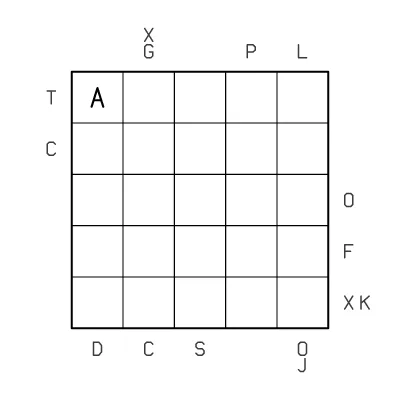
ABC Path
ABC Path — A to Y, each letter touching the next, guided by edge clues
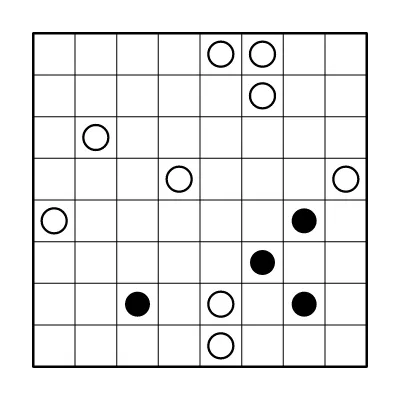
Binairo
Binairo — balance two symbols with no three alike and no twin lines
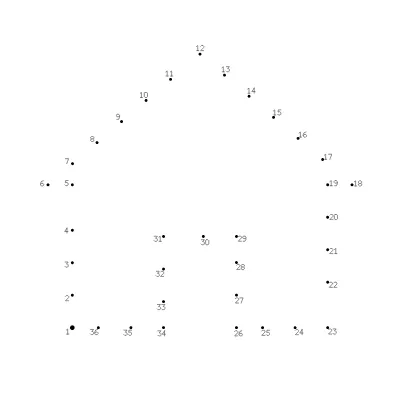
Dot-to-Dot
Connect the dots — parametric silhouettes with verified dot separation
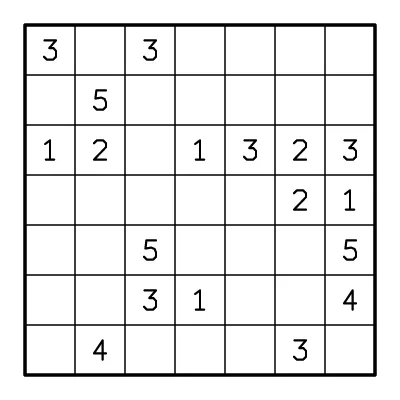
Fillomino
Partition the grid into regions, each cell holding the size of its own