Binairo
Logic puzzlev1.0.0Binairo — balance two symbols with no three alike and no twin lines.
Fill the grid with two symbols: no three alike in a line, equal counts in every line, and no two identical lines.
What it is
A square grid, even-sided, partly seeded with white and black circles. Three rules finish it: no three consecutive cells in a row or column may match, every row and column holds exactly half of each symbol, and no two rows — or two columns — may be identical.
How to play
The opening moves are local: a pair (●●) caps itself at both ends, and a
gap between twins (●_●) must break them. When those run dry, count — a line
that has spent its quota of one symbol fills the rest with the other. The
expert move is the twin rule: a finished line forbids its duplicate, which
can pin the last open cells of a nearly-matching one.
Purpose
The most widely published binary-logic genre — newspapers run it as “Binary Puzzle” or “Takuzu” — and a natural fit for the shared solver’s two-value domain machinery, which nonogram, kakurasu and slitherlink already exercise. It also adds a constraint form the engine lacked: pairwise distinctness of whole lines.
History
Published as Binairo by Belgian setters Peter De Schepper and Frank Coussement in 2009, and independently as Takuzu and Unruly. The genre’s ancestry runs through Games Magazine’s Tohu wa Vohu.
This implementation
- Spec knobs:
size(even, 6–12),difficulty,cell,line. - Generation: randomised depth-first fill of a full valid grid, then symbols are dug out one at a time while the technique ladder still finishes the board at the requested difficulty’s ceiling.
- Solving: four propagators, one per human rung — the pair/gap moves (naked single), line counting (hidden single), whole-line enumeration under both in-line rules (the combination rung), and the finished-twin rule (hidden pair).
- Guarantees: deterministic per seed; exactly one solution, proven by exhaustive count; the printed board solves by inference alone, and the rating is the hardest technique the solve actually used.
More logic puzzles
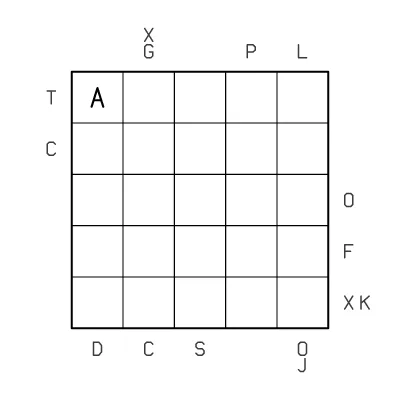
ABC Path
ABC Path — A to Y, each letter touching the next, guided by edge clues
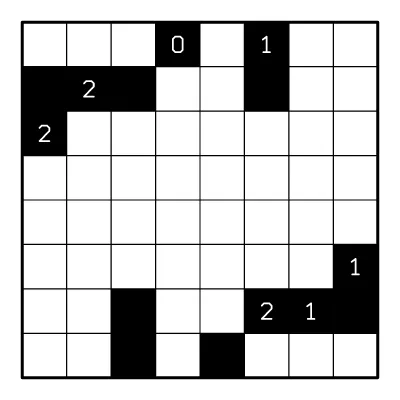
Akari (Light Up)
Place bulbs to light every cell, with no two bulbs shining on each other
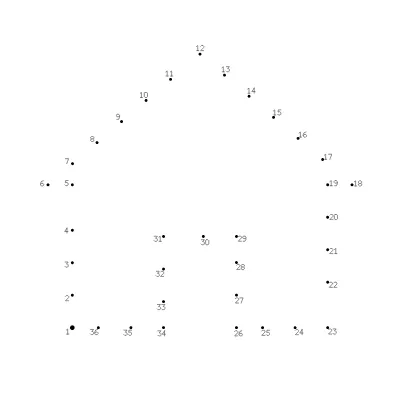
Dot-to-Dot
Connect the dots — parametric silhouettes with verified dot separation
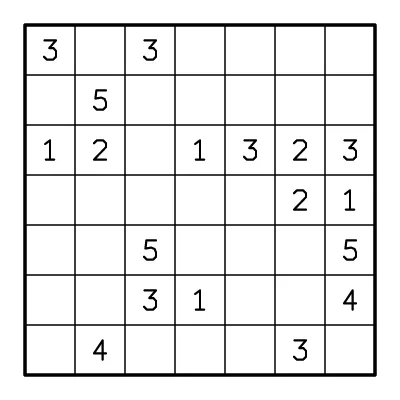
Fillomino
Partition the grid into regions, each cell holding the size of its own