Codeword
Word puzzlev1.0.0Codeword — a filled crossword in cipher, unique against its vocabulary.
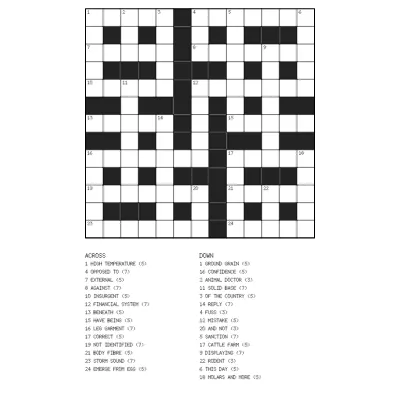
A filled crossword in cipher: every cell shows a number, the same number always means the same letter, and a few given letters are the foothold from which the whole substitution is recovered.
What it is
A criss-cross of interlocking words with the letters replaced by numbers (1 up to the count of distinct letters on the page). A legend below the grid tracks the cipher; the given letters are filled in both grid and legend.
How to play
Start from the givens: every cell carrying their numbers is now known. Look
for word shapes those letters force — a three-letter slot _ E _ crossing a
known R narrows fast — and each solved word donates all its letters to the
cipher. The puzzle is finished when the legend is complete.
Why it is in the catalogue
The most popular pencil puzzle absent from the catalogue’s first thirty-seven — a staple of every puzzle magazine under the names Codeword, Codebreaker, Cipher Crossword and Kaidoku. It reuses the criss-cross discipline wordfit established (grown skeleton, one crossing per join, no adjacencies) and adds the substitution layer on top.
History
Cipher crosswords appeared in British puzzle magazines in the mid-20th century and became a fixture under the Codeword name; the Japanese publisher Nikoli runs the same form as Kaidoku. Unlike the crossword there are no clues at all — the vocabulary itself is the constraint set.
The implementation’s guarantees
- Uniqueness is claimed against a declared vocabulary, and proved. A
human solves with all of English; a generator cannot ladder that honestly.
What is proved instead: given the grid, the givens and this crate’s word
list (or the spec’s own), exactly one number→letter assignment makes every
slot spell a distinct listed word. The solver that proves it is in the
crate, and the metadata names the basis:
givens_against_vocabulary. - Givens are revealed until uniqueness holds, starting from the difficulty’s allowance (Easy 4, Medium 3, Hard 2) and the measured count is what the difficulty is read from — fewer givens is harder, and the reported difficulty follows the count actually needed, not the one requested.
- The skeleton grows with its fill (a slot is only added with a word committed), and word choice prefers candidates bringing new letters, so the cipher typically spans 14–24 letters.
- The answer key ships as a second scene: full grid and full legend.