Crossword
Word puzzlev1.0.0Symmetric crossword grids filled from a clued wordlist.
Fill the symmetric grid from numbered clues, across and down.
What it is
A square grid of white and black cells, conventionally with 180° rotational symmetry. Numbered white cells start the entries; each across and down entry has a clue. Every white cell belongs to both an across and a down word (fully checked grids), so each letter is confirmed twice.
How to play
Answer what you know, pencil what you suspect, and let crossings settle disagreements. Short entries recur across published puzzles (crosswordese rewards experience); long entries yield to patterns once a few crossings are in. In a well-made grid every letter is checked by two words, so a wrong guess collides quickly.
Purpose
The prestige word puzzle, and the hardest of the three word-grid crates: it needs a clued, scored wordlist, which is a data-acquisition problem as much as an algorithmic one. The crate exists because the grid-filling machinery is shared with wordfit; the wordlist quality is the ongoing investment.
History
Invented by Arthur Wynne — a Liverpudlian journalist — for the New York World, published 21 December 1913 as a diamond-shaped “Word-Cross”. The 1920s made it a craze; The Times of London capitulated in 1930; the cryptic tradition forked in Britain while American grids standardised on full checking and rotational symmetry.
This implementation
- Spec knobs:
size,max_blocks,theme,difficulty. - Generation: symmetric block placement under connectivity and minimum-word-length constraints, then backtracking fill with most-constrained-slot-first over the scored wordlist; clues come with the list entries.
- Guarantees: the grid is connected, symmetric, fully filled from the list, and every entry has a clue; the fill is deterministic per seed.
- Difficulty: wordlist scoring tier and grid openness (block count, average entry length), banded.
More word puzzles
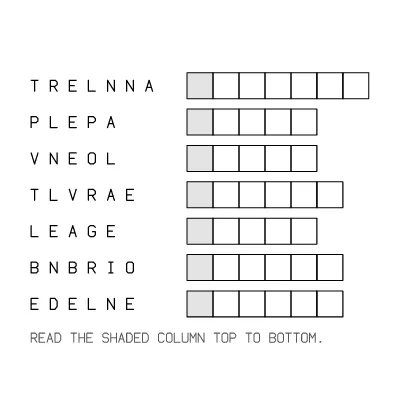
Acrostic
Acrostic — unscramble each row, read the initials for the hidden word
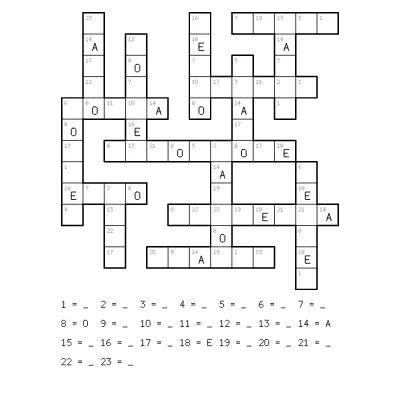
Codeword
Codeword — a filled crossword in cipher, unique against its vocabulary
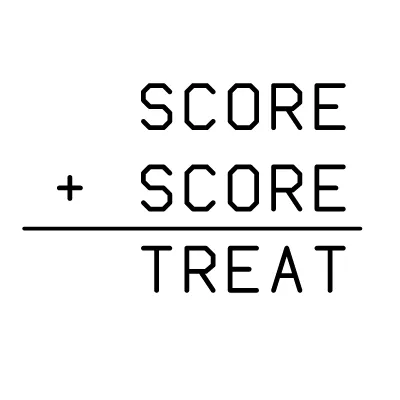
Cryptarithm
An addition in letters, with exactly one way to read it as digits
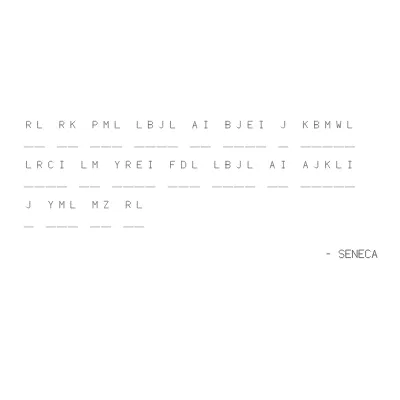
Cryptogram
Substitution ciphers over public-domain quotes, with a frequency table