Futoshiki
Logic puzzlev1.0.0Futoshiki — a Latin square constrained by printed inequality signs.
A Latin square with inequality signs: fill 1..n once per row and column, and
obey every printed <.
What it is
An n×n grid holding each of 1..n exactly once per row and column — the
Latin-square rule sudoku shares — with chevrons printed between some
neighbouring cells. The chevron points at the smaller value. Very few digits
are given; the signs do the work.
How to play
Start where a sign chain forces its ends: in a 5×5, a run a < b < c < d < e
along a row pins all five. Elsewhere, bounds reasoning narrows candidates —
a cell on the large side of a sign cannot hold 1 — and the Latin-square rule
finishes the job.
Why it is in the catalogue
The clearest demonstration of the shared engine’s leverage: futoshiki is a
one value per cell puzzle, so rows and columns are AllDifferent
(unchanged since sudoku), uniqueness and thinning are count_solutions and
reduce_while_unique, and the rating is the technique ladder. The only new
code is the inequality propagator — about seventy lines of bounds reasoning.
History
Published by Tamaki Seto in Japan (2001) and popularised internationally by The Guardian from 2006 under the name Futoshiki (“not equal”); also sold as Hutosiki and Unequal.
The implementation’s guarantees
- Uniqueness and no guessing, both proved on the board that ships: the
ladder must finish it below
Backtrack, andis_uniqueis re-checked independently of the thinning loop. - Both kinds of clue are thinned: digits first, then signs, each while the ladder can still finish unaided — a futoshiki printed with every possible sign is a chore, not a puzzle, and the test refuses both extremes.
- The answer is checked against the rules directly (
obeys) before any search runs, so a bug in the propagator cannot hide behind one in the generator. - Signs are drawn as paths, not glyphs: the first render used
∧/∨text for vertical pairs and the embedded font had neither, so every vertical sign silently vanished. A path cannot go missing. - Rating basis:
technique_ladder— a measurement of the work, not a proxy.
More logic puzzles
ABC Path
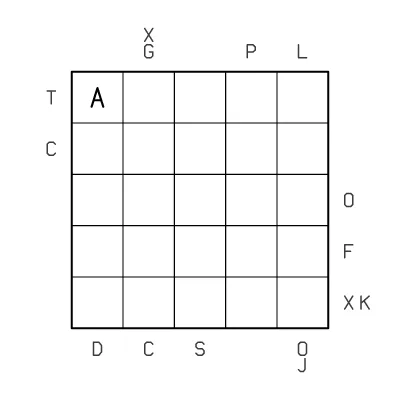
ABC Path — A to Y, each letter touching the next, guided by edge clues
Akari (Light Up)
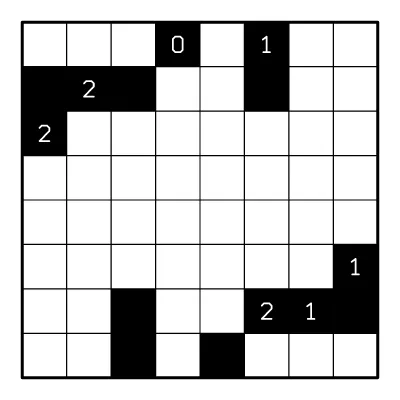
Place bulbs to light every cell, with no two bulbs shining on each other
Binairo
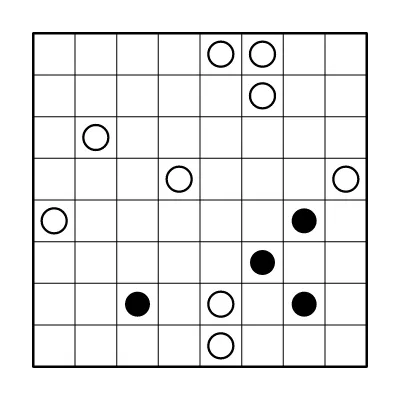
Binairo — balance two symbols with no three alike and no twin lines
Dot-to-Dot
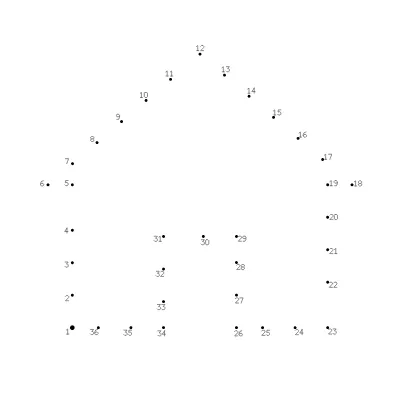
Connect the dots — parametric silhouettes with verified dot separation