Harmonograph
Designv1.0.0Damped pendulum figures, with frequencies nudged off exact ratios so they precess.
The figures a swinging table draws: damped pendulums, slightly detuned so the curve precesses instead of retracing itself.
What it is
A simulation of the Victorian drawing machine: two damped pendulums per axis, each contributing a decaying sine to the pen’s position. The frequencies are near-integer ratios — near, not exact, because an exact ratio closes and retraces one path forever, while a few thousandths of detune makes the figure precess, drawing the same shape at slowly turning angles. Damping spirals the line inward, giving the pages their dense rims and open centres.
How to use
Colouring and contemplation pages — the fine interference bands between line
passes take pencil shading beautifully. damping sweeps from constant-width
bands (0) toward centre-spiralling figures; detune controls how fast the
figure turns as it draws; several figures nest per page.
Purpose
The physical-simulation entry in the design lane, and the crate that documents a measurement lesson: “does the pen travel far enough” cannot detect a retraced circle (it travels far), so degeneracy is caught by a revisit factor — travel divided by ground covered — where the retraced circle scores 7.8 and a healthy rosette 2.1.
History
Invented around the 1840s, usually credited to Scottish mathematician Hugh Blackburn; by the 1870s harmonographs were parlour fixtures, drawing Lissajous-adjacent figures for entertainment. The machine is a physical demonstration of the same mathematics as Lissajous curves (1855), with decay added by honest friction.
This implementation
- Spec knobs:
size,figures,detune,damping,steps,stroke,kids. - Generation: four pendulums (two per axis) with small-integer base frequencies, signed detune, per-pendulum damping variation; sampled evenly in time (which is what the pen does — fast mid-swing, slow at the ends); figures screened by taste checks (sliver, revisit factor, damped-to-a-dot) and near-duplicate rejection against every earlier figure on the page.
- Guarantees: deterministic per seed; every figure fits the page (scaled by its own extent); colourability-gated with figure-count escalation.
More designs
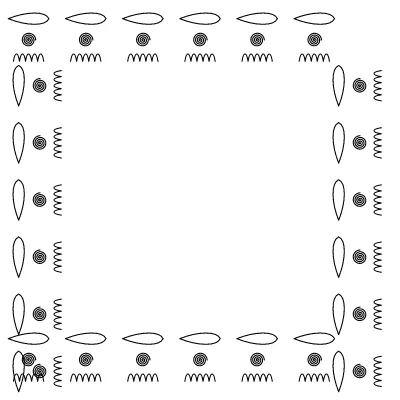
Border
Ornamental borders — the seven frieze groups over the motif library
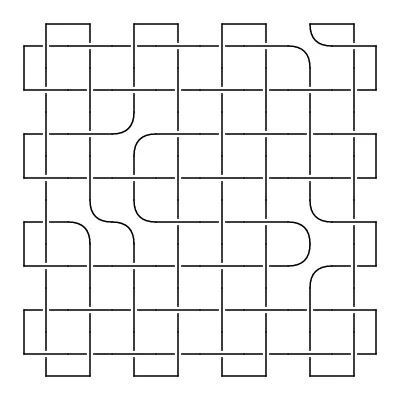
Celtic Plait
An interlaced plait: cords passing over and under, with cells that turn them back
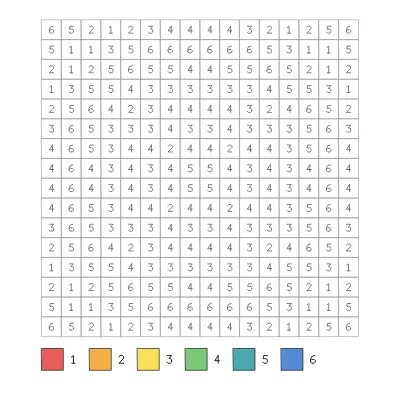
Colour by Number
Colour by number — a numbered grid that colours into a symmetric design
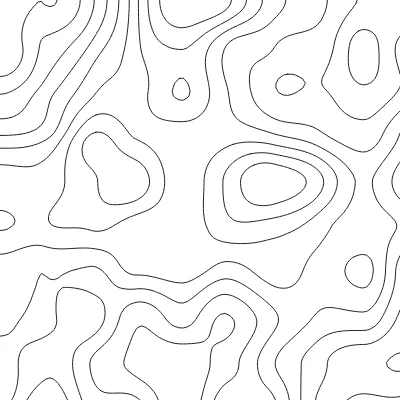
Contour
Contour lines — a seeded heightfield's level sets, terrain-map style