Hashi (Hashiwokakero)
Logic puzzlev1.0.0Join the islands with bridges, clued by how many each one takes.
Connect the numbered islands with bridges: each island’s number is how many bridge ends it takes, and everything must join up.
What it is
Circled numbers (“islands”) on a grid. Islands are joined by horizontal or vertical bridges — at most two between any pair, never crossing another bridge or island. Each island’s number says exactly how many bridges touch it, and the finished network must be connected.
How to play
Saturated islands come first: an “8” takes double bridges in all four directions; a corner “4” is fully forced. An island with number 2k and k neighbours takes at least one bridge to each. Draw what is forced, recount, repeat. Keep connectivity in mind late in the solve — a move that would seal off a satisfied sub-network is wrong.
Purpose
The only workspace puzzle whose answer is a graph rather than a colouring or a partition — bridges, degrees, planarity. It renders beautifully sparse, which makes it a good breather page between dense grids.
History
Nikoli, 1989. Hashi wo kakero means “build bridges!”. Published in English as Hashi or Bridges; the mechanic descends from graph-realisation questions — degree sequences made playable.
This implementation
- Spec knobs:
rows,cols,islands,difficulty. - Generation: answer first — islands are placed on the lattice, a connected planar multigraph (≤2 edges per pair, no crossings) is built over them, and each island’s clue is its degree in that graph.
- Guarantees: the degree sequence admits exactly one bridge layout, proven by a bounded search whose variables are the candidate pairs (0, 1 or 2 bridges each) with degree and crossing checked incrementally and connectivity as the final test.
- Difficulty: forced-move ratio and degree distribution, banded.
More logic puzzles
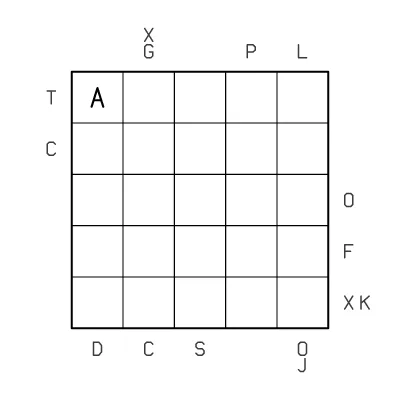
ABC Path
ABC Path — A to Y, each letter touching the next, guided by edge clues
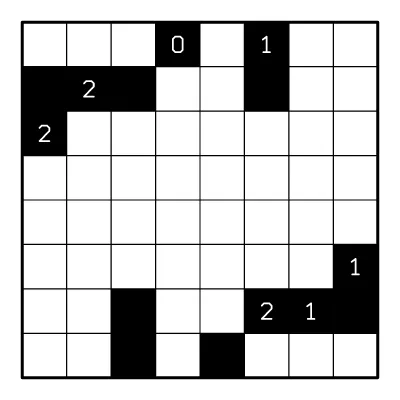
Akari (Light Up)
Place bulbs to light every cell, with no two bulbs shining on each other
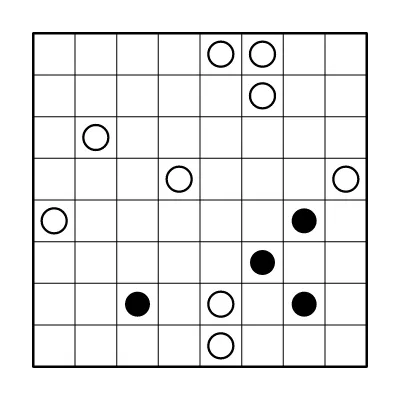
Binairo
Binairo — balance two symbols with no three alike and no twin lines
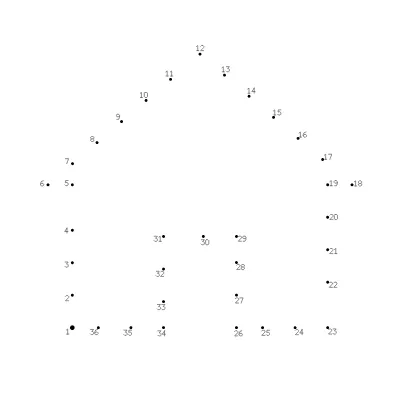
Dot-to-Dot
Connect the dots — parametric silhouettes with verified dot separation