Hitori
Logic puzzlev1.0.0Shade cells until no number repeats in any row or column.
Shade out cells until no number repeats in any row or column — without ever shading two neighbours or cutting the board in two.
What it is
A grid filled with numbers. Some cells must be shaded (eliminated) so that: no number appears twice among the unshaded cells of any row or column; no two shaded cells share an edge; and the unshaded cells remain one connected region.
How to play
Look for patterns: in “a b a”, the middle cell must survive, so the outer pair resolves around it; a number sandwiched between two copies of another number is forced unshaded. When shading a cell, immediately circle its neighbours as safe. Watch connectivity — a shading that would strand a corner is wrong even if the numbers allow it.
Purpose
The subtractive counterpart to sudoku: instead of writing digits in, you cross them out. Its three rules prune in three different ways (locally, per line, globally), which made it the workspace’s cleanest example of layering incremental checks over a final global one.
History
Nikoli, 1990. The full name is Hitori ni shite kure — “leave me alone” — after the goal of making every number solitary in its lines.
This implementation
- Spec knobs:
rows,cols,symbols,difficulty. - Generation: a near-Latin grid is built, duplicates are introduced deliberately, and the shading that fixes them is verified unique.
- Guarantees: the shipped answer passes all three rules (checked against
the rule definition before the solver runs), and
count(2) == Exact(1)from a bounded search — hitori is NP-complete, so the budget exists, and running out of it rejects the board rather than trusting it. - Cross-check: the solver’s count is tested against an exhaustive sweep of all 2⁹ shadings of a 3×3 — the pruning is an optimisation of exactly that enumeration, and the test is what makes it trustworthy.
- A fact worth knowing: a duplicate-free grid is legal with nothing shaded, and shading a unique number is pointless but not illegal — so a Latin square admits many legal shadings, and “no duplicates” alone is nowhere near a puzzle. The generator works from that fact rather than against it.
More logic puzzles
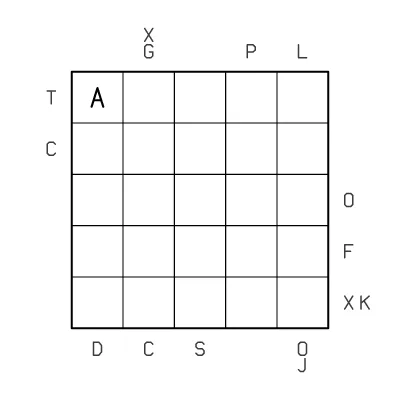
ABC Path
ABC Path — A to Y, each letter touching the next, guided by edge clues
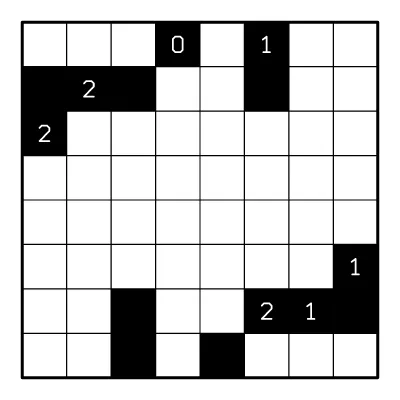
Akari (Light Up)
Place bulbs to light every cell, with no two bulbs shining on each other
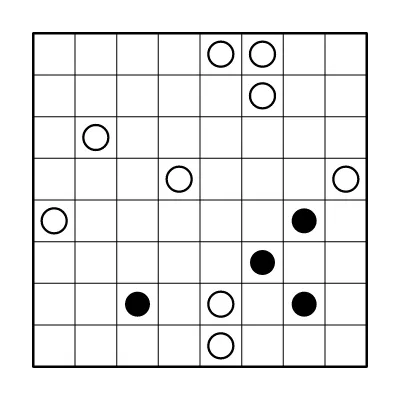
Binairo
Binairo — balance two symbols with no three alike and no twin lines
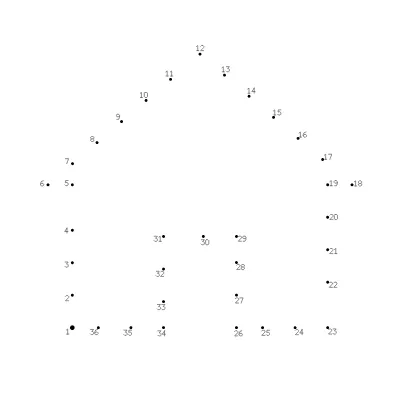
Dot-to-Dot
Connect the dots — parametric silhouettes with verified dot separation