Kakurasu
Logic puzzlev1.0.0Kakurasu — shade cells so every line sums to its position clue.
Shade cells so that every line’s shaded positions add up to its clue.
What it is
A binary shading grid. The number beside a row is the sum of the column positions of that row’s shaded cells — shading the 1st, 3rd and 4th columns gives 1 + 3 + 4 = 8. The number under a column is the same sum over row positions. Grey rulers along the top and left show what each position is worth.
How to play
Start with the extremes: a clue of 0 empties its line, and the maximum (1+2+…+n) fills it. Elsewhere, work out which subsets of positions can reach the clue — a row of six needing 3 can only be {3} or {1,2} — and cross-check against the column clues.
Why it is in the catalogue
The catalogue’s first binary puzzle on the shared engine: the alphabet is two values rather than 1..n, which is worth having as proof the solver is not secretly a Latin-square engine. Everything but the clue rule is reused.
History
A modern computer-era puzzle, popularised by Otto Janko’s puzzle collection and by Grandgames/Puzzle-Team under the names Kakurasu and Index Sums.
The implementation’s guarantees
- The clue rule is exact, not bounds arithmetic: the propagator enumerates the subsets still consistent with the assigned cells and eliminates any state absent from all of them. A line is at most 8 cells (256 subsets), so exactness is affordable — and it is what lets the ladder finish boards instead of stalling.
- Uniqueness and no guessing are proved on the board that ships, and a test additionally checks that the unique solution is the shading the generator drew — uniqueness alone would not say that.
- Clues are thinned while the ladder can still finish unaided; a 6×6 typically prints 9 of the 12 slots.
- Rating basis is named honestly:
clue_density_with_ladder_floor. This puzzle has one rule, so the hardest technique is always the same and the ladder alone cannot separate boards — what varies is how many clues survived thinning, and the metadata says so rather than dressing density up as a technique measurement.
More logic puzzles
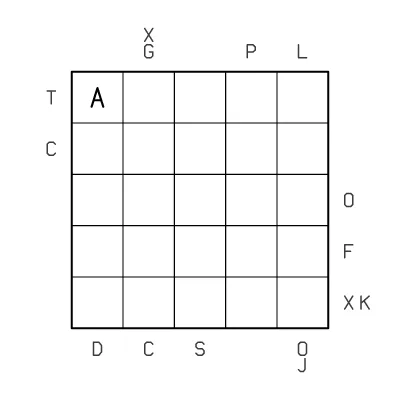
ABC Path
ABC Path — A to Y, each letter touching the next, guided by edge clues
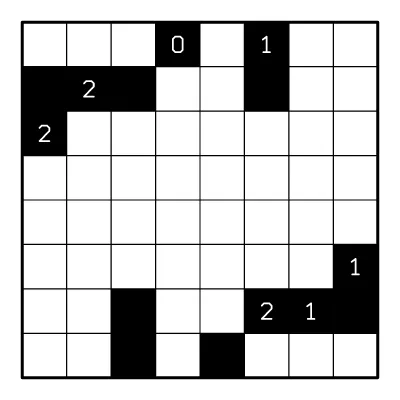
Akari (Light Up)
Place bulbs to light every cell, with no two bulbs shining on each other
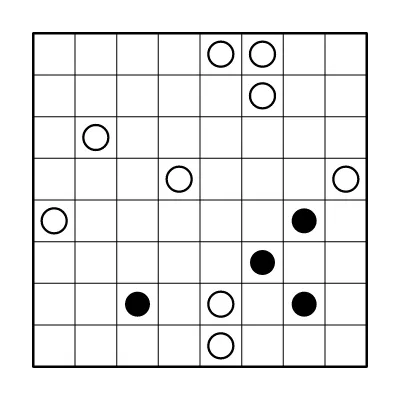
Binairo
Binairo — balance two symbols with no three alike and no twin lines
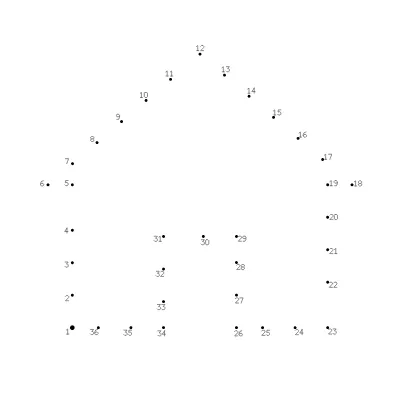
Dot-to-Dot
Connect the dots — parametric silhouettes with verified dot separation