Kuromasu (Kurodoko)
Logic puzzlev1.0.0Black out cells so every number counts the white cells its own cell can see.
Black out cells so every number counts exactly the white cells its own cell can see.
What it is
A grid, some cells carrying numbers. Cells may be blacked out — but never a numbered cell, never two blacks side by side, and the white cells must remain one connected area. Each number equals the count of white cells visible from its cell along the four directions (itself included), with sight stopped by black cells and the board edge.
How to play
Numbers equal to their maximum possible view mean no black anywhere in sight — mark those lines safe. Small numbers demand nearby blacks: a “2” in open space needs its view walled to one neighbour. Every black you place must keep its neighbours white (no two blacks touch), which chains: black here means white there, which extends some number’s view, which may force another black. Connectivity arbitrates the endgame.
Purpose
A sight-line puzzle to sit beside akari: both are about beams, but where akari places lights, kuromasu carves the room. In the workspace it is the crate that proved clue sparsity can be a useless difficulty signal — its minimal boards all keep nearly the same number of clues, so it rates by measured search effort instead.
History
Nikoli, 1991, under the name Kurodoko (“where are the black cells”). Kuromasu (“black squares”) is the name that travelled west.
This implementation
- Spec knobs:
rows,cols,black_share,difficulty. - Generation: answer first — blacks are placed greedily (legality checked per placement, so the pass cannot get stuck), a number is read off every white cell, then numbers are thinned while the board keeps exactly one answer — and that answer is verified to be the constructed one.
- Guarantees:
count_answers(2) == 1; the search is cross-checked against brute force over every black/white pattern of three small boards under five clue sets each. - Difficulty: search nodes per cell (
rating_basis: search_nodes_per_cell), reported alongside the band. Measured before banding: ten 7×7 boards all kept 9 clues and 9 blacks, while proof effort spread 49–379 nodes — an 8:1 range where clue count did not move at all.
More logic puzzles
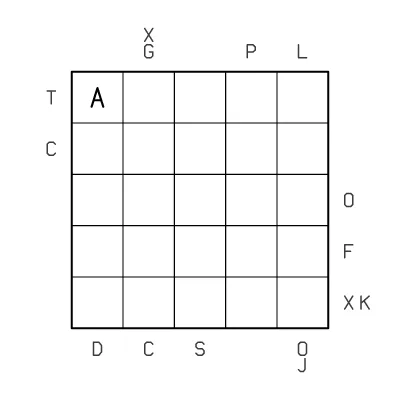
ABC Path
ABC Path — A to Y, each letter touching the next, guided by edge clues
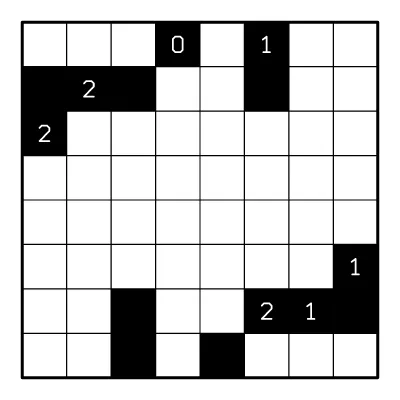
Akari (Light Up)
Place bulbs to light every cell, with no two bulbs shining on each other
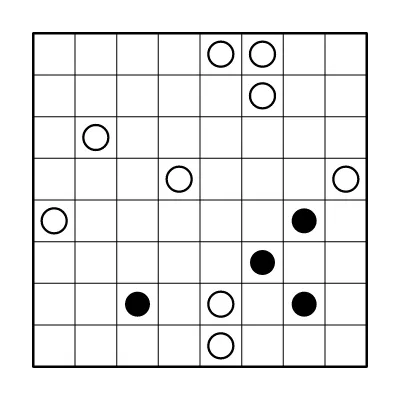
Binairo
Binairo — balance two symbols with no three alike and no twin lines
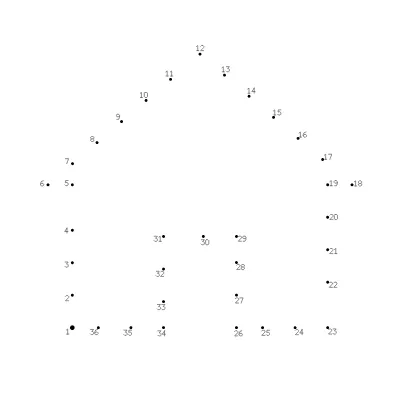
Dot-to-Dot
Connect the dots — parametric silhouettes with verified dot separation