Labyrinth
Designv1.0.0Unicursal labyrinths — one corridor, classical or seeded, proven single-path.
One corridor, folded into concentric circuits, leading from the entrance to the centre. No junctions, no dead ends, no decisions — a labyrinth is walked or traced, not solved.
What it is
A unicursal (single-path) design in the classical tradition: n concentric
circuits with every turn stacked on one axis. The corridor visits each
circuit exactly once, in an order — the level sequence — that determines
the labyrinth’s whole character. The famous Cretan pattern is the sequence
3, 2, 1, 4, 7, 6, 5 over seven circuits: in to the third circuit, out to
the first, then inward to the seventh and back to the fifth before the
centre.
How to use it
Trace the corridor with a finger or pencil from the entrance to the centre —
there is exactly one way — or colour the corridor and the wall band as two
regions. The meanders figure in the metadata counts how often the path
reverses direction between inward and outward: a spiral scores 0, the
classical seven scores 2, and seeded designs usually score more.
Why it is in the catalogue
The maze lane’s unicursal cousin, and a category of its own in activity and mindfulness books. It is a design, not a puzzle: the mandatory verification is geometric — the built corridor is proven not to touch itself anywhere, and the level sequence is proven valid — rather than a solver proving a solution unique.
History
The classical pattern is among the oldest abstract designs in continuous use: it appears on a clay tablet from Pylos (c. 1200 BCE), on Cretan coins of the 4th century BCE — the association with the Minotaur myth named the whole form — and carved and laid from Galicia to Gotland. The medieval church tradition (Chartres cathedral’s pavement labyrinth, c. 1201, is the canonical example) elaborated it to eleven circuits with turns on four axes. The single-axis family this generator draws is the classical one; the sequence notation used here follows the labyrinth-typology literature (Kern, Through the Labyrinth, 2000).
The implementation’s guarantees
- Unicursal by construction and by check. The level sequence is validated (each side of the axis must nest its turns like brackets), and the built corridor centreline is separately proven never to approach itself closer than 0.8× the ring pitch — the geometry and the sequence maths cannot share a mistake.
- Classical style uses the Cretan seed-pattern sequence where one exists for the circuit count (3, 7, 11, 15, 19); other counts fall back to a seeded valid sequence. Orientation and handedness still vary by seed, so no seed is dead.
- Random style searches the whole valid single-axis family with the seeded RNG — every page a different labyrinth with identical guarantees.
- Colourability is checked with the adult rules and the wall stroke thins on retry if ink coverage asks for it. The corridor is one enormous region; the wall band is another.
- Rating basis: none — there is no difficulty, which is the point. The honesty fields are the sequence itself, the meander count, and the corridor width in points.
More designs
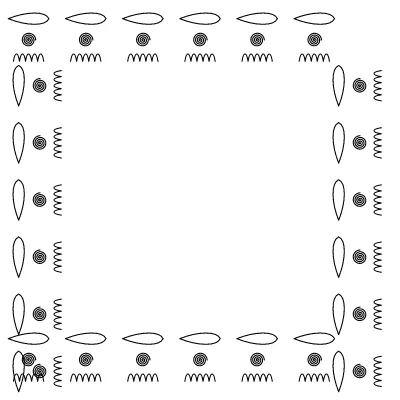
Border
Ornamental borders — the seven frieze groups over the motif library
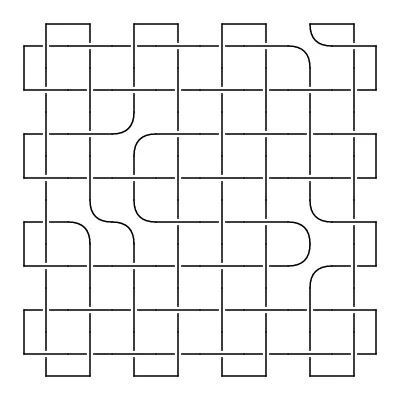
Celtic Plait
An interlaced plait: cords passing over and under, with cells that turn them back
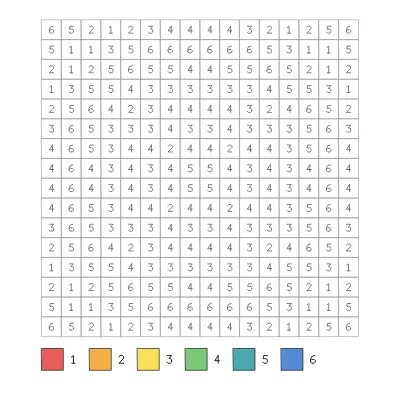
Colour by Number
Colour by number — a numbered grid that colours into a symmetric design
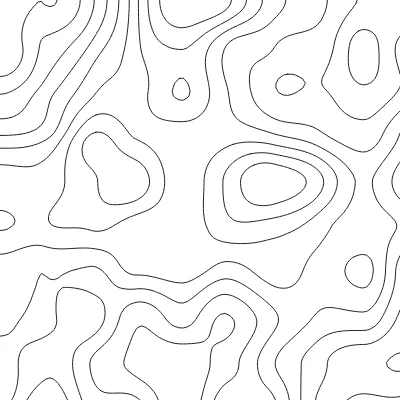
Contour
Contour lines — a seeded heightfield's level sets, terrain-map style