LITS
Logic puzzlev1.0.0Shade one L, I, T or S tetromino in every region, all joined, with no two alike touching.
Shade one tetromino in every region — L, I, T or S — all connected, no 2×2 block, and no two identical shapes touching.
What it is
A grid divided into regions of four or more cells. In each region exactly four cells are shaded, forming an L, I, T or S tetromino (the square is excluded — it would break the next rule anyway). All shaded cells across the board form one connected mass; no 2×2 area is fully shaded; and two tetrominoes of the same shape may never share an edge. Rotations and reflections count as the same shape.
How to play
Four-cell regions are their own answer — shade them whole and name the shape. Work adjacency from there: a placed S forbids any S against it, which often leaves a neighbouring region only one option. The 2×2 rule polices corners where regions meet, and global connectivity decides between the last few candidates. There are no numbers anywhere — the region borders are the entire clue.
Purpose
The only clueless puzzle in the collection, which makes it the purest test of the workspace’s uniqueness machinery: nothing can be thinned, so uniqueness has to be built, by moving cells between regions until only the intended shading survives.
History
Invented by Naoki Inaba as Nuruomino, adopted and renamed LITS by Nikoli in 2004 — the name is simply the four usable tetromino letters.
This implementation
- Spec knobs:
rows,cols,difficulty. - Generation: four attempts documented in the crate, each killed by a measurement — blind region carves gave 90% zero-answer boards (0/160 unique); greedy piece placement saturated at 57% density (regions too big to pin); a 2×2-blocking lattice made density worse. The shipped construction packs tetrominoes with a hole budget to 73–75% density (regions ≈ 5.4 cells, where published LITS sits), draws regions around the pieces, then repairs boundaries — a second answer diagnoses exactly which region had a choice, and one cell moves to remove it.
- Guarantees: exactly one shading, verified against the rule definition; the shape classifier is pinned by enumerating all 19 fixed tetrominoes (2 I, 1 square, 4 T, 8 L, 4 S) — an invariant like neighbour-count multisets cannot tell L, S and I apart, so the classifier canonicalises all eight orientations instead.
- Difficulty: search nodes per cell, with thresholds measured on LITS itself — its proofs cost ~0.2 nodes/cell where kuromasu’s cost 1–11, so borrowed cuts would have rated every board Kids.
More logic puzzles
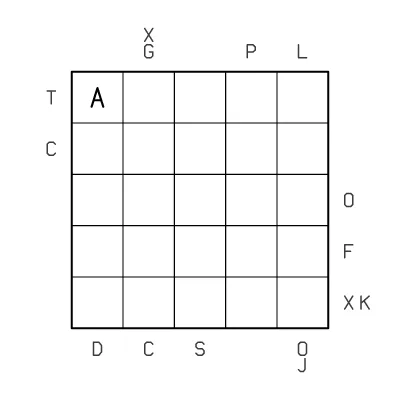
ABC Path
ABC Path — A to Y, each letter touching the next, guided by edge clues
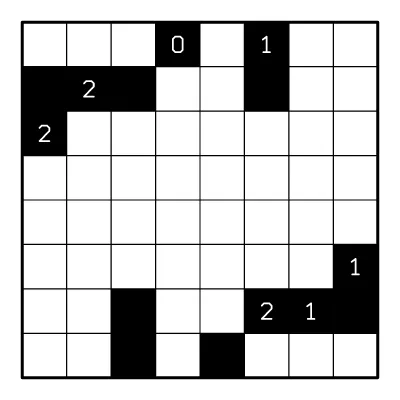
Akari (Light Up)
Place bulbs to light every cell, with no two bulbs shining on each other
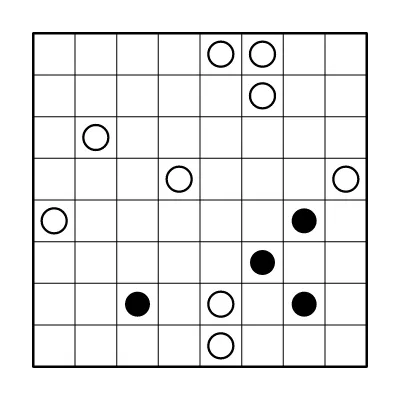
Binairo
Binairo — balance two symbols with no three alike and no twin lines
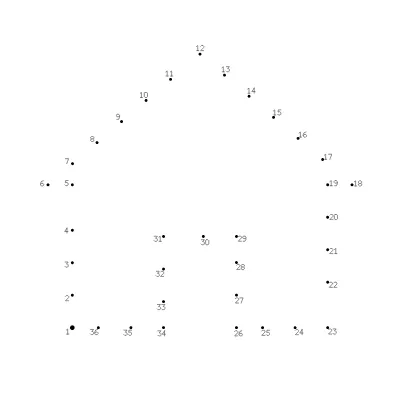
Dot-to-Dot
Connect the dots — parametric silhouettes with verified dot separation