Logic Grid
Logic puzzlev1.0.0Logic grids with relational clues, minimised to the smallest sufficient set.
Deduce who owns what from relational clues — the zebra-puzzle formula, with a tick-and-cross grid to track it.
What it is
A cast of entities (people, houses, pets…) each holding one value per attribute (a colour, a drink, a position…). A list of clues — “the tall one is older than the baker”, “Ana does not live in the red house” — pins down exactly one assignment. The classic solving aid is a grid of every attribute-pair, ticked and crossed as facts land.
How to play
Enter the direct clues first (Is / IsNot become ticks and crosses). Every
tick crosses out its whole row and column within that attribute block. Ordered
clues (“before”, “older than”) exclude the extremes: whoever is before
someone cannot be last. The grid multiplies information — a cross in one block
plus a tick in another yields a cross in a third. When stuck, look for the
attribute pair with only one open cell.
Purpose
The only non-spatial puzzle in the collection — pure relational deduction, no geometry — and the one that reads most like a story, which makes it the anchor of themed books. The workspace’s clue minimisation is the point: a published clue list with a redundant clue reads as padding.
History
The form descends from Einstein’s Riddle / the Zebra Puzzle, first printed in Life International (December 1962) — attributed to Einstein or Lewis Carroll by legend, with no evidence for either. Dell and Penny Press built the tick-grid presentation into a durable magazine genre from the 1960s on.
This implementation
- Spec knobs:
entities,attributes,theme,difficulty. - Generation: a random full assignment is drawn (anchor attribute fixed to kill relabelling symmetry — without that, “unique” is meaningless), a candidate clue set is emitted from relational templates, then minimised: clues are removed while the assignment stays the only one consistent.
- Guarantees: exactly one assignment satisfies the shipped clues, and every surviving clue is load-bearing — removing any one of them admits a second assignment.
- Difficulty: clue count against the theoretical minimum, plus inference chain depth, banded.
More logic puzzles
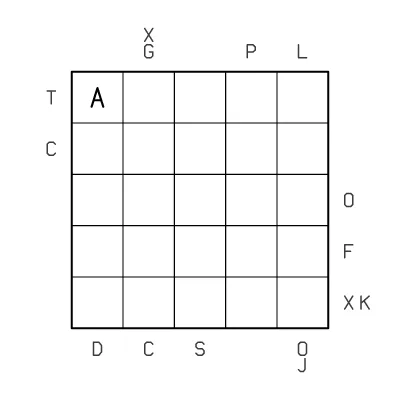
ABC Path
ABC Path — A to Y, each letter touching the next, guided by edge clues
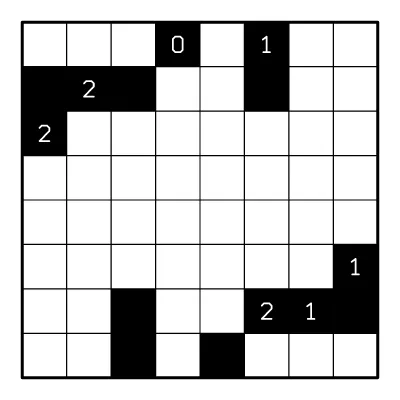
Akari (Light Up)
Place bulbs to light every cell, with no two bulbs shining on each other
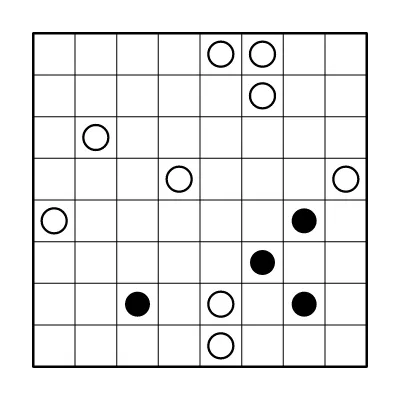
Binairo
Binairo — balance two symbols with no three alike and no twin lines
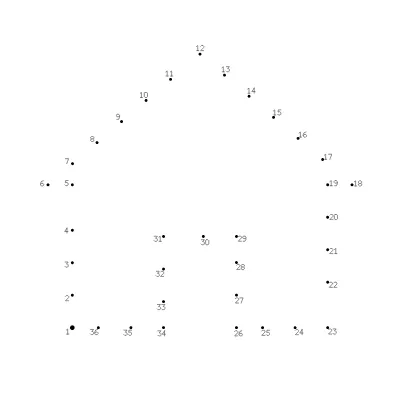
Dot-to-Dot
Connect the dots — parametric silhouettes with verified dot separation