L-System
Designv1.0.0Ferns, vines and fractals from stochastic L-systems, with fillable leaves.
Ferns, vines and fractals grown from rewriting rules, drawn by a turtle with fillable leaves.
What it is
A Lindenmayer system: an axiom string and rewriting rules, expanded a fixed number of generations, then interpreted by a turtle — draw forward, turn, push and pop position. Presets cover ferns, trees, vines and classical fractals; stochastic rules add natural variation, and closed leaf shapes are attached at branch tips so the pages are colourable rather than mere line skeletons.
How to use
Botanical pages colour like botanical illustration — stems dark, leaves in
gradient families. The fractal presets (dragon curve, Sierpinski arrowhead)
are tracing exercises as much as colouring. depth controls complexity;
jitter and stochastic rules keep two pages from the same preset visibly
different.
Purpose
The organic counterweight to the geometric design crates — everything else in the lane is compass-and-straightedge, this one grows. Its corner flourishes also feed the mandala crate’s border bands conceptually: closed, fillable curve-work at arbitrary scale.
History
Aristid Lindenmayer, a Hungarian botanist, introduced the formalism in 1968 to model algae growth. Przemysław Prusinkiewicz’s The Algorithmic Beauty of Plants (1990) made it the canonical computer-graphics plant model; the turtle interpretation borrows from Logo (Papert, 1967).
This implementation
- Spec knobs:
preset,depth,angleoverride,leaf_scale,jitter,taper, plus a free-formaxiom/rulesescape hatch for custom grammars. - Generation: bounded-depth expansion (growth is exponential — the cap is a promise, not a suggestion), turtle interpretation to beziers, leaves as closed paths so the colourability gate has regions to check.
- Guarantees: deterministic per seed — stochastic rule choices draw from the seeded stream; degenerate grammars (unbounded or empty output) are rejected with an explanation rather than drawn.
More designs
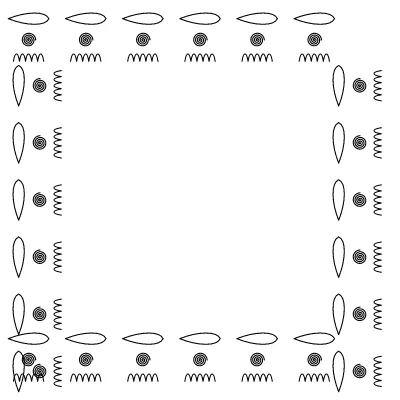
Border
Ornamental borders — the seven frieze groups over the motif library
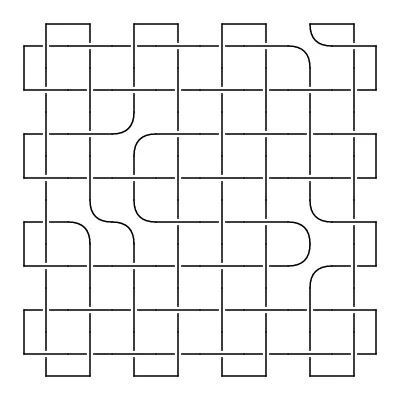
Celtic Plait
An interlaced plait: cords passing over and under, with cells that turn them back
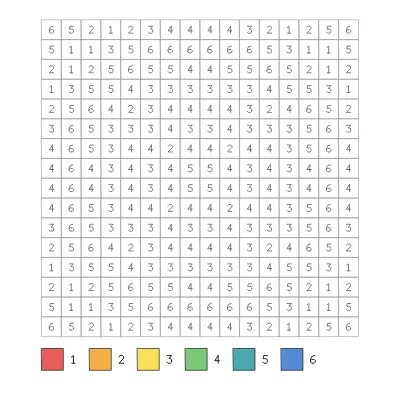
Colour by Number
Colour by number — a numbered grid that colours into a symmetric design
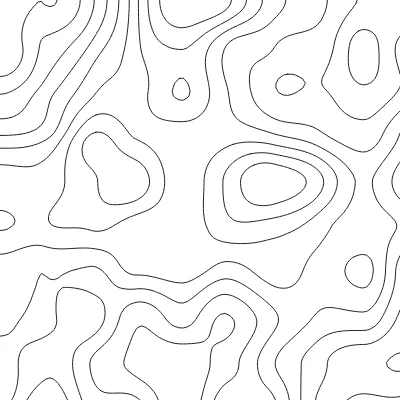
Contour
Contour lines — a seeded heightfield's level sets, terrain-map style