Mandala
Designv1.0.0Circular, square and polygonal rosettes from a symmetric fundamental domain.
Circular, square and polygonal rosettes built from a symmetric fundamental domain — colouring pages with mathematical bones.
What it is
A radially symmetric line-art design: rings of parametric motifs (petals, arcs, leaves, scallops, dots, chevrons) repeated around a centre under a rotation group (Cₙ) or a dihedral group (Dₙ, adding mirror symmetry). Rectangular “mandalas” use the same machinery as border bands, which also yields ornamental page frames.
How to use
These are colouring pages: every region is closed, so any region can take a flat colour without bleeding. Colourists typically work ring by ring, alternating palettes; the symmetry means one decision per ring, repeated. Adult profiles allow fine detail; the kids profile enforces fatter strokes and larger regions.
Purpose
The flagship of the design lane and the first proof of the workspace’s motif-and-symmetry architecture: motifs are parametric bezier builders (not clipart), so twelve families × parameter ranges × symmetry groups gives effectively unlimited non-repeating pages. Colourability is a gate — pages failing region size, stroke width or ink coverage are regenerated with fewer elements, never shipped with a note.
History
Maṇḍala is Sanskrit for “circle”: in Hindu and Buddhist practice, a diagram of the cosmos used in ritual and meditation — Tibetan sand mandalas being the famous ephemeral form. Carl Jung brought the word into Western psychology as an archetype of wholeness; the 2010s adult-colouring boom made the rosette form a publishing staple.
This implementation
- Spec knobs:
size,frame(circular/rect/polygon),symmetry(Cn/Dn/mirror/frieze/wallpaper),rings,motifs,density,stroke,ring_lines,hollow_center. - Generation: one fundamental domain (a wedge of 2π/n, half-wedge for
Dₙ) is populated with collision-checked motifs, then instanced by affine
transforms — the symmetry service in
lako-geomshared by every design crate. - Guarantees: deterministic per seed; colourability-gated with escalation (density backs off before a page ships unfixable; tiling pages also grow their cell and thin their stroke, floored at the print minimum).
- Frieze and wallpaper: real tiling symmetries, not rosette aliases — the domain is sized to one lattice cell and stamped by the group, with all 17 wallpaper groups and 7 frieze groups pinned colourable by a full-matrix test. The lattice cell is a spec value inside the symmetry, clamped to a fifth-to-half of the page.
More designs
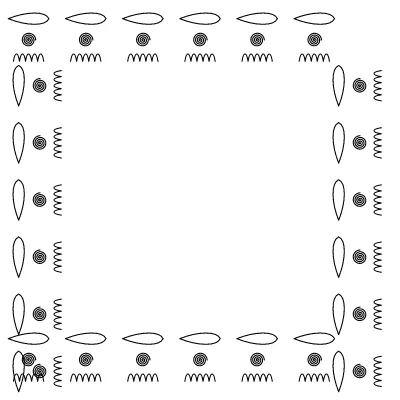
Border
Ornamental borders — the seven frieze groups over the motif library
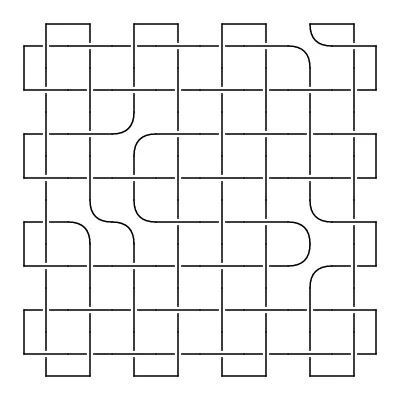
Celtic Plait
An interlaced plait: cords passing over and under, with cells that turn them back
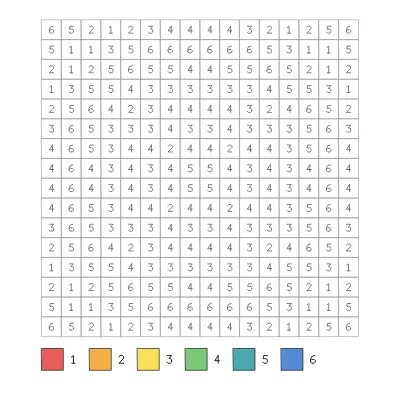
Colour by Number
Colour by number — a numbered grid that colours into a symmetric design
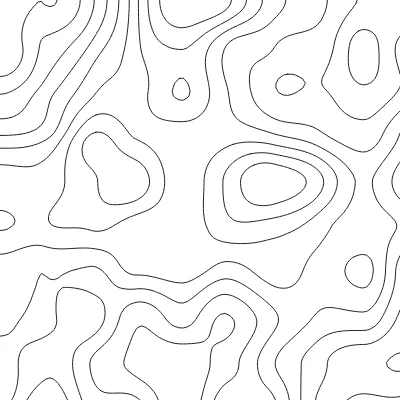
Contour
Contour lines — a seeded heightfield's level sets, terrain-map style