Nonogram
Logic puzzlev1.0.0Picture logic puzzles, proven solvable by line reasoning alone.
Picture logic: shade cells so each row and column matches its run-length clues, revealing a hidden picture.
What it is
A grid with numbers along the top and left. Each number list describes the runs of filled cells in that row or column, in order, with at least one blank cell between runs. Solving the grid correctly reveals a small picture — a heart, a cat, a boat.
How to play
Work line by line. If a 15-wide row is clued “12”, the middle nine cells are filled in every legal placement — mark them. Rows and columns feed each other: every cell fixed in a row narrows its column, and the puzzle finishes by bouncing between the two directions. Mark known-blank cells with a dot; they are as informative as filled ones.
Purpose
The most visual of the logic puzzles — the only one whose answer is a picture, which makes it a favourite for younger solvers and for themed books. It also carries the workspace’s strictest quality bar: a nonogram that needs guessing is rejected outright, because no human solves one that way.
History
Invented independently in the late 1980s by Non Ishida (a Tokyo graphics editor, via a skyscraper-lights design competition) and puzzle author Tetsuya Nishio. Serialised in Japanese magazines from 1988, brought to The Sunday Telegraph in 1990 under the name nonogram (after Ishida). Also known as picross, griddlers, hanjie, and paint-by-numbers.
This implementation
- Spec knobs:
rows,cols,picture(a named silhouette or random texture),densityfor the random pictures. - Generation: render the picture to a bitmap, derive the clues, then
verify the grid is solvable by line reasoning alone — the O(n·k)
reachability line solver in
lako-solver::line. Named silhouettes are re-rendered slightly fatter or leaner across retries until a line-solvable thickness is found, rather than abandoning the requested picture. - Guarantees: line solving makes only forced deductions, so completing the grid is the uniqueness proof — no separate solution count is needed.
- Difficulty: the number of full sweeps the line solver needed; more passes means more row/column cross-referencing.
More logic puzzles
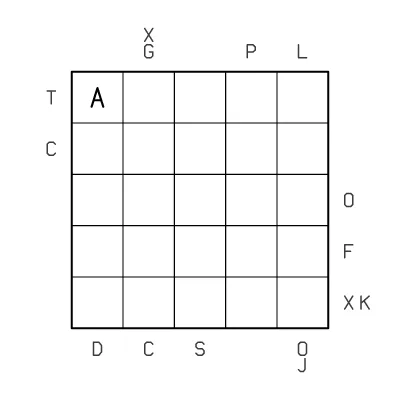
ABC Path
ABC Path — A to Y, each letter touching the next, guided by edge clues
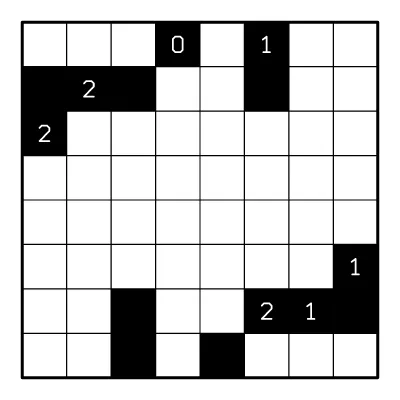
Akari (Light Up)
Place bulbs to light every cell, with no two bulbs shining on each other
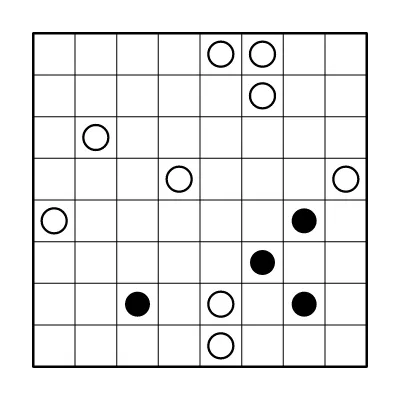
Binairo
Binairo — balance two symbols with no three alike and no twin lines
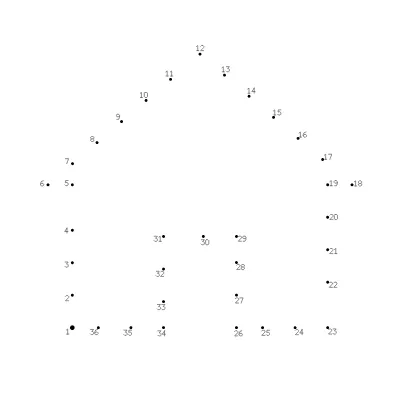
Dot-to-Dot
Connect the dots — parametric silhouettes with verified dot separation