Numbricks
Logic puzzlev1.0.0Numbricks — 1 to n² snaking through the grid, one step at a time.
Fill the grid with 1 to n² so that consecutive numbers touch — up, down, left or right, never diagonally.
What it is
A single snaking path visiting every cell, with a handful of numbers printed to anchor it. Also published as Numbrix (Marilyn vos Savant’s version, from Parade magazine in 2008) and as Hidato’s orthogonal cousin.
How to play
Work outward from the given numbers, and inward from the ends: 1 and n² are
always printed, so the path’s start and finish are known. Between two givens
k and k + 4 there must be a route exactly four steps long, which usually
leaves one option.
Why it is in the catalogue
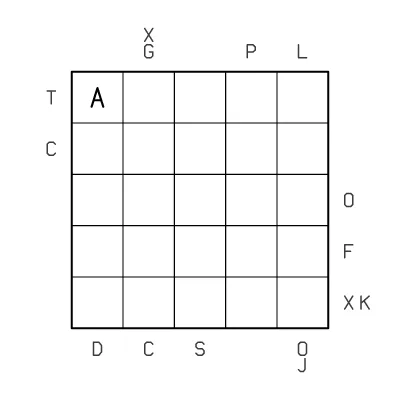
The sibling of ABC Path, and the difference is instructive: orthogonal adjacency (four neighbours instead of eight) makes the path far more constrained, which is why numbricks can print five clues on a 5×5 where ABC Path needs sixteen edge labels.
The implementation’s guarantees
- The adjacency propagator reasons forward: a number’s successor lives in the neighbourhood of wherever the number could be, so one pin cascades along the single thread. (Written fresh rather than shared with ABC Path — generator crates never depend on each other — but with its lesson already learned.)
- The random path uses a Warnsdorff bias (visit the most constrained neighbour first), which turns a search that stalls on a 5×5 into one that lands almost immediately.
- The endpoints are never thinned away: a numbricks without 1 and n² printed is a different, much harder puzzle, and a test says so.
- Uniqueness and no guessing are proved on the board that ships, and the ladder’s solution is checked to be the generated snake.
- Rating basis:
surviving_clue_count, named honestly — one rule means the ladder cannot separate boards. - Size is capped at 5×5 by the solver’s 32-value ceiling (a 6×6 would need 36 values).
More logic puzzles
ABC Path
ABC Path — A to Y, each letter touching the next, guided by edge clues
Akari (Light Up)
Place bulbs to light every cell, with no two bulbs shining on each other
Binairo
Binairo — balance two symbols with no three alike and no twin lines
Dot-to-Dot
Connect the dots — parametric silhouettes with verified dot separation