Phyllotaxis
Designv1.0.0Phyllotaxis — golden-angle floret spirals, sunflower heads and petal disks.
Florets placed by the golden angle: floret n sits at angle n · 137.507…°
and radius c·√n, and the sunflower’s spiral arms appear without ever being
drawn.
What it is
Vogel’s 1979 model of seed-head growth. The golden angle — the circle divided by the golden ratio — is the unique divergence that packs florets evenly at every radius; the apparent left- and right-winding spiral families (parastichies) count consecutive Fibonacci numbers. Two floret styles: dots (seed head) and radially oriented petals (dahlia).
How to use it
A colouring disk: every floret is a closed region. Set angle to 90 or 99.5
to see exactly why the golden angle is special — rational angles collapse
into spokes.
History
Spiral phyllotaxis was measured by botanists from the 1830s (the
Bravais brothers); Helmut Vogel’s compact r = c√n model dates to 1979, and
the golden-angle explanation was made rigorous by Douady and Couder’s 1992
physics experiments.
The implementation’s guarantees
- Florets never touch, measured: Vogel’s model promises ≈
cnearest-neighbour spacing; the floret radius banks on it and a pairwise test verifies it rather than trusting the asymptotics. - The colourability lever is floret count (fewer florets = larger florets at fixed page size); the surviving count is reported beside the requested one.
- Seeded orientation and chirality; the divergence angle is a spec knob with the golden angle as default.
- Rating basis: none — a design. Honesty fields: floret count, divergence, style, attempt.
More designs
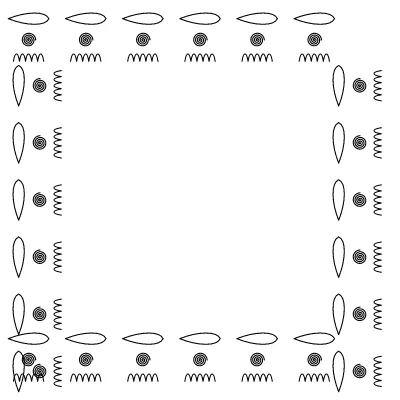
Border
Ornamental borders — the seven frieze groups over the motif library
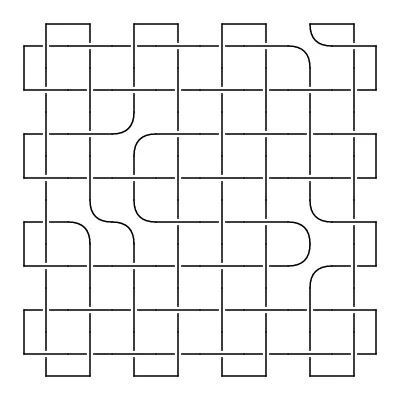
Celtic Plait
An interlaced plait: cords passing over and under, with cells that turn them back
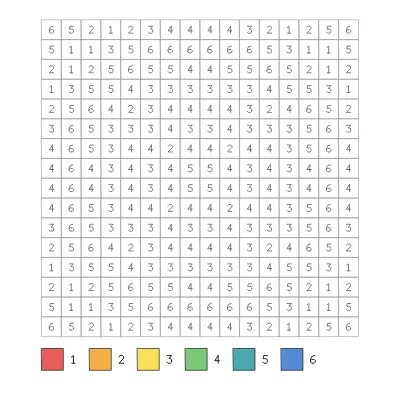
Colour by Number
Colour by number — a numbered grid that colours into a symmetric design
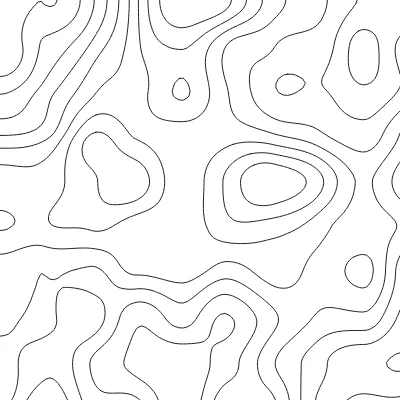
Contour
Contour lines — a seeded heightfield's level sets, terrain-map style