Shakashaka
Logic puzzlev1.0.0Place half-cell triangles so every white area left over is a rectangle.
Place half-cell triangles so that every white area left over is a rectangle — upright or tilted 45°.
What it is
A grid with some black cells, a few of them numbered. Any white cell may hold a right triangle filling half of it (four orientations). A number counts the triangles in the four cells beside it. The defining rule: when the triangles are in, every connected scrap of white must form a rectangle — either aligned with the grid or turned 45° like a diamond.
How to play
Numbers drive placement: a “0” keeps all four neighbours empty, higher counts force triangles in. The shape rule does the rest — a triangle’s hypotenuse starts a diagonal edge that must continue in the neighbouring cell, or the white area it borders acquires a 45° corner that no rectangle has. Follow each diagonal until it closes a diamond or meets black. Empty rectangular areas are perfectly legal; the numbers tell you where the diamonds were meant to be.
Purpose
The last generator added, deliberately deferred: its rectangle rule needs a checker that cannot serve as its own oracle, so the checker was built and tested first — boundary-walked at quarter-cell resolution in doubled integer coordinates — and the search brute-force-verified against it. The crate is the workspace’s reference for “the checker comes before the generator”.
History
Nikoli, 2008, credited to Guten. The name is onomatopoeia — shaka shaka, the sound of shaking — and Nikoli’s own subtitle for it translates as “proof of the pudding”. It is among the youngest puzzles Nikoli made canonical.
This implementation
- Spec knobs:
rows,cols,diamond_share,difficulty. - Generation: random black cells give no solvable boards at all (0/24 measured, three densities) — every white scrap must end rectangular, and ragged areas cannot be fixed by triangles. So the board is built: guillotine cuts make white rooms (already rectangles, already legal), diamonds are planted in 2×2 rooms, numbers are read off the walls and thinned while the arrangement stays unique.
- Guarantees: exactly one arrangement, and it is the constructed one. The rectangle test has fixtures for the shapes that fool simpler tests — triangle (fills its rotated bounding box), hole, pinch — and the local corner prune (white runs of 2, 4 or 8 wedges only) is proven sound by exhaustive enumeration of small boards. That test caught a wedge-ordering bug that made the prune reject the diamond itself.
- Difficulty: search nodes per cell, thresholds from measured quintiles (2.3–17.4 across 30 boards).
More logic puzzles
ABC Path
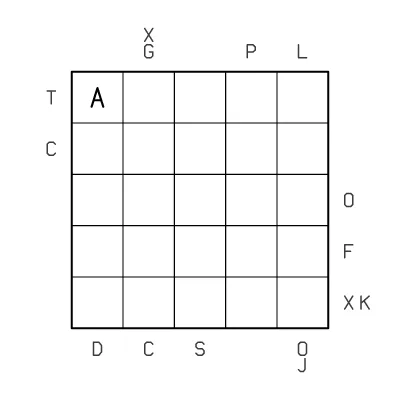
ABC Path — A to Y, each letter touching the next, guided by edge clues
Akari (Light Up)
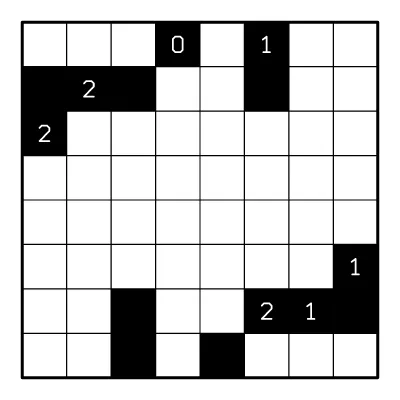
Place bulbs to light every cell, with no two bulbs shining on each other
Binairo
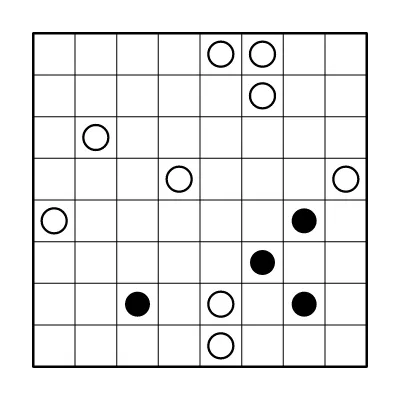
Binairo — balance two symbols with no three alike and no twin lines
Dot-to-Dot
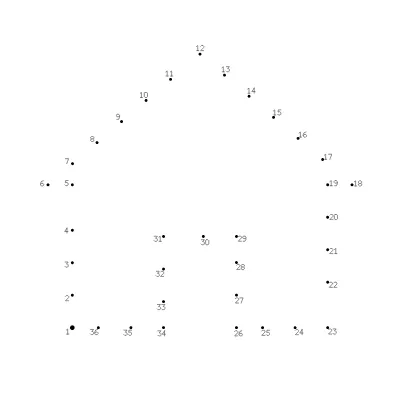
Connect the dots — parametric silhouettes with verified dot separation