Shikaku
Logic puzzlev1.0.0Partition a grid into rectangles, one numbered clue per rectangle.
Divide the grid into rectangles, one per clue, each covering exactly its clue’s number of cells.
What it is
A grid with numbered cells. The whole grid must be cut into axis-aligned rectangles so that each rectangle contains exactly one number, and that number equals the rectangle’s area. No gaps, no overlaps.
How to play
Prime numbers are friendly: a 5 must be a 1×5 strip, and near an edge its orientation is often forced. For each clue, sketch every rectangle of its area that covers it without swallowing another clue — cells covered by every candidate are certainly that clue’s. Cells only one clue can reach resolve next. The tiling closes like a zip once a few rectangles are fixed.
Purpose
The gentlest of the partition puzzles — pure area arithmetic, no arcane rules — which makes it a staple of kids’ sections. In the workspace it is the textbook exact-cover search: columns are cells, rows are candidate rectangles, most-constrained-clue-first.
History
Nikoli, credited to founder Maki Kaji — reportedly his favourite of the puzzles he invented. The full name Shikaku ni kire means “cut into squares (rectangles)”.
This implementation
- Spec knobs:
rows,cols,mean_area,difficulty. - Generation: answer first — the grid is partitioned into rectangles, one clue is placed per rectangle (position randomised), and the exact-cover search proves the clue set admits exactly one tiling.
- Guarantees:
count(2) == Exact(1); the areas sum to the cell count, so covering each cell at most once means exactly once, and no separate gap check is needed (the module docs prove it). A search-budget overrun rejects the board — “probably unique” is not a claim this workspace makes. - Performance note: every candidate rectangle’s cell list is computed once and cached; recomputing it in the inner loop is what once turned a 20×20 from milliseconds into minutes.
- Difficulty: the size of the candidate space (placements per clue), banded — a proxy, and labelled as one.
More logic puzzles
ABC Path
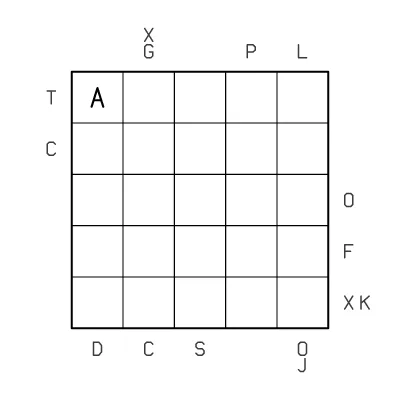
ABC Path — A to Y, each letter touching the next, guided by edge clues
Akari (Light Up)
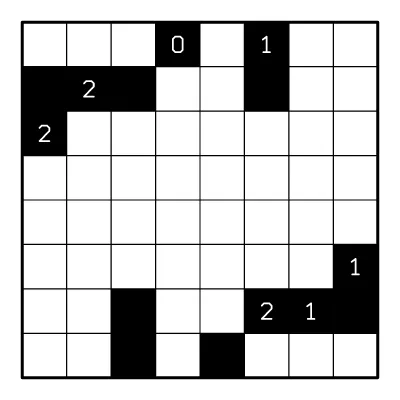
Place bulbs to light every cell, with no two bulbs shining on each other
Binairo
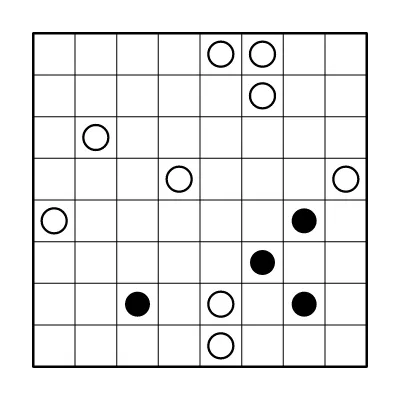
Binairo — balance two symbols with no three alike and no twin lines
Dot-to-Dot
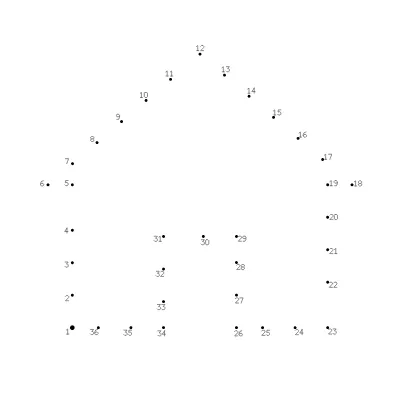
Connect the dots — parametric silhouettes with verified dot separation