Skyscrapers
Logic puzzlev1.0.0Skyscrapers — a Latin square read from its edges by visibility counts.
Each cell holds a building 1..n tall, once per row and column; the numbers outside say how many buildings are visible from that side.
What it is
A Latin square read from its edges. Looking along a line, a building is visible only if every building before it is shorter — so a clue of 1 means the tallest stands nearest, and a clue of n means the line ascends step by step. Everything between is deduction.
How to play
The extremes go in first (1 and n force whole lines). After that, work out which arrangements of a line are still consistent with what you know and its clue: heights that appear in none of them are impossible.
Why it is in the catalogue
The third one value per cell puzzle on the shared engine, after ripple and
futoshiki: rows and columns are AllDifferent, uniqueness and thinning are
the shared routines, the rating is the technique ladder. The only new code is
the visibility clue.
History
A Japanese puzzle-magazine staple (also Building, Towers, Wolkenkratzer) popularised worldwide through Croco-Puzzle and the World Puzzle Championship, where it is a regular round.
The implementation’s guarantees
- The clue rule is a line solver, not rules of thumb. The first version implemented the three deductions a person names first (clue 1 forces the tallest, clue n forces the ascent, height caps by position) and the ladder could not finish a single board: those prune the extremes and say almost nothing about the middle clues, which are most of a page. The propagator now enumerates the arrangements still consistent with the domains and eliminates heights absent from all of them — affordable because a line is at most 7 cells, pruned by domains and by running visibility.
- It sits on the ladder at
SumCombination, the rung kakuro’s combination reasoning uses, and for the same reason: one clue’s own bookkeeping, no cross-referencing. - Uniqueness and no guessing are proved on the board that ships, and the
answer is checked against the rules directly (
obeys) before any search. - Clues are thinned while the ladder can still finish unaided — the shipped 5×5 typically prints 8–10 of the 20 possible.
- Rating basis:
technique_ladder.
More logic puzzles
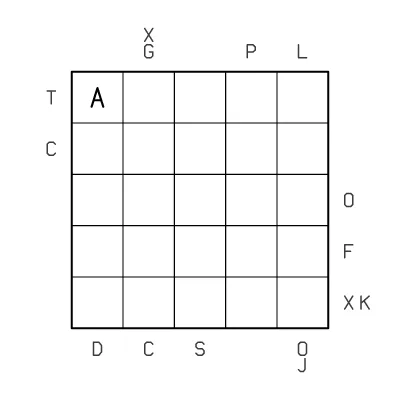
ABC Path
ABC Path — A to Y, each letter touching the next, guided by edge clues
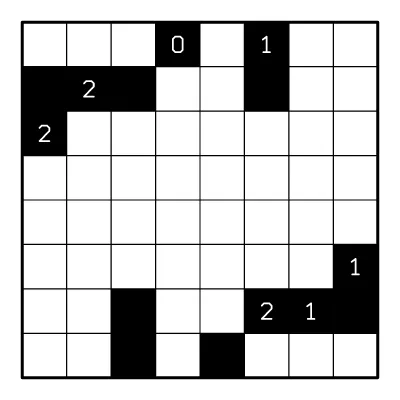
Akari (Light Up)
Place bulbs to light every cell, with no two bulbs shining on each other
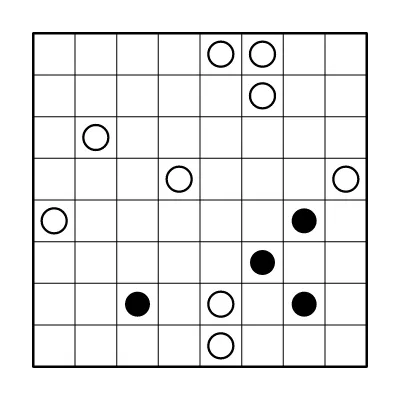
Binairo
Binairo — balance two symbols with no three alike and no twin lines
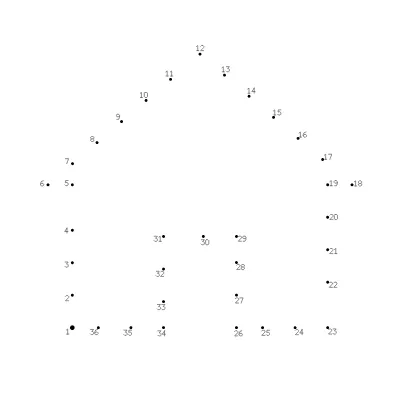
Dot-to-Dot
Connect the dots — parametric silhouettes with verified dot separation