Slant (Gokigen Naname)
Logic puzzlev1.0.0Fill every cell with a diagonal, matching the corner counts and closing no loop.
Fill every cell with a diagonal so the circled numbers count their touching diagonals — and no diagonals form a loop.
What it is
Every cell of the grid gets exactly one diagonal, / or \. Circled numbers
sit on the lattice points between cells: each counts how many of the (up to
four) surrounding diagonals touch that point. And the diagonals may never
close a loop.
How to play
Corners and edges first: a corner point touches one cell, so its number (0 or
- decides that cell instantly. A “4” takes all four diagonals into its
point; a “0” pushes all four away. The loop rule does the quiet work — the
smallest possible loop is a diamond of four diagonals (
/\over\/), and avoiding it forces late cells. Track connected chains: joining two ends of the same chain is exactly what a loop is.
Purpose
The only puzzle here where every cell is filled and the clues live on points rather than cells — a genuinely different geometry that exercises the grid renderer. Its loop rule is implemented as a union-find, the same machinery a maze carver uses, shared conceptually if not in code.
History
Nikoli, published as Gokigen Naname (roughly “in a diagonal mood”). Western publishers standardised on Slant, after Simon Tatham’s popular open-source implementation of it.
This implementation
- Spec knobs:
rows,cols,clue_share,difficulty. - Generation: answer first — a loop-free diagonal filling is built (the
Forestunion-find with an undo log makes trial placements cheap), point counts are read off it, clues are thinned while unique. - Guarantees: exactly one filling satisfies the printed numbers; the solver was cross-checked against brute force over every diagonal filling of a 2×3.
- A lesson recorded: the star of four diagonals meeting at a point is a tree, not a loop — the actual minimal cycle is the diamond, an assumption the brute-force sweep corrected. Difficulty bands were re-centred on the measured clue-density spread after by-eye thresholds put every board in Hard and cost 8× in retries.
More logic puzzles
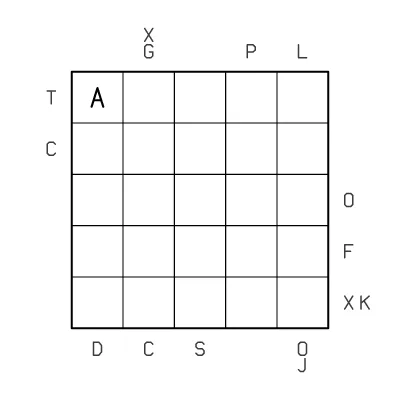
ABC Path
ABC Path — A to Y, each letter touching the next, guided by edge clues
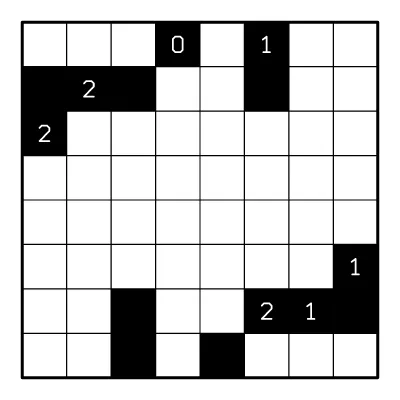
Akari (Light Up)
Place bulbs to light every cell, with no two bulbs shining on each other
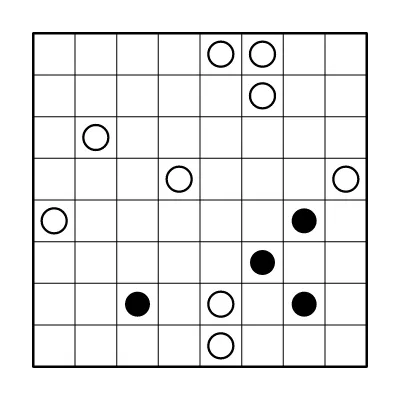
Binairo
Binairo — balance two symbols with no three alike and no twin lines
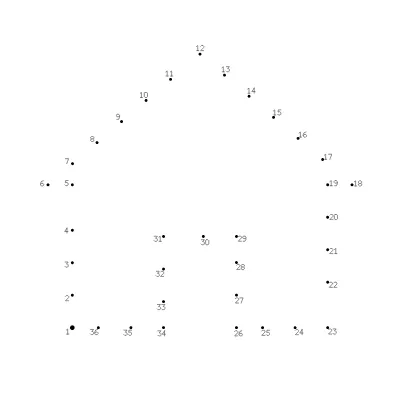
Dot-to-Dot
Connect the dots — parametric silhouettes with verified dot separation