Slitherlink
Logic puzzlev1.0.0Draw one closed loop, clued by how many edges each cell touches.
Draw a single closed loop along the grid lines so each clue counts the edges drawn around its cell.
What it is
A lattice of dots. Some cells between the dots carry a number 0–3: exactly that many of the cell’s four edges are part of the loop. The loop is one simple closed curve — it never branches, never crosses itself, and there is only one of it.
How to play
Zeros are gifts: no edge touches them, and a 3 beside a 0 is nearly forced. Corners and edges constrain hard — a 3 in a corner takes both outer edges. Track dot degrees: every dot on the loop has exactly two drawn edges, so a dot with two edges decided excludes the rest. The single-loop rule closes the game: never complete a small cycle while cells remain unsatisfied.
Purpose
The archetypal loop puzzle and one of Nikoli’s “big four”. In the workspace it is the hardest solver honestly bounded: slitherlink is NP-complete, the search carries four proof-based prunes, a worklist propagator, and a union-find over dots — and its development history (including a rollback bug that could have called ambiguous boards unique) is recorded in the module docs as a warning.
History
Nikoli, 1989, credited as a collaboration refined by founder Maki Kaji. Published in English as Slitherlink, Fences, Loop the Loop and Dotty Dilemma. It remains one of the most-analysed pencil puzzles in computer science.
This implementation
- Spec knobs:
rows,cols,clue_share,difficulty. - Generation: answer first — a closed loop is grown on the dual grid as a
random simple polygon (the
latticemodule, shared throughlako-grid), every cell’s edge count is read off it, then clues are removed while the loop stays unique. - Guarantees: exactly one loop satisfies the printed clues; the search is cross-checked against brute force over every clue subset of a small board — the test that once caught a union-find rollback bug no ordinary fixture would have found.
- Difficulty: which clue patterns the deduction needed, banded; raw search nodes reported alongside.
More logic puzzles
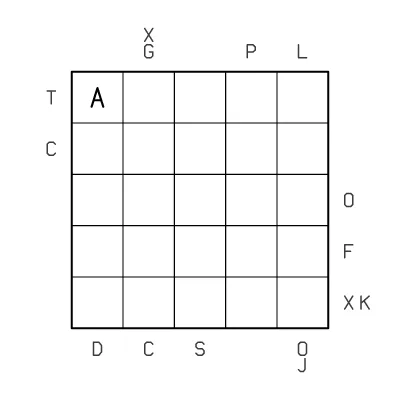
ABC Path
ABC Path — A to Y, each letter touching the next, guided by edge clues
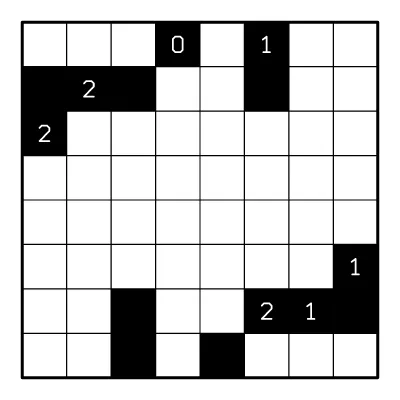
Akari (Light Up)
Place bulbs to light every cell, with no two bulbs shining on each other
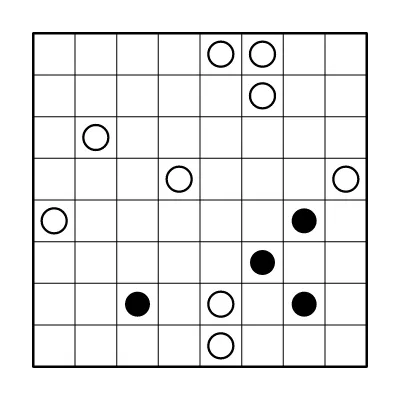
Binairo
Binairo — balance two symbols with no three alike and no twin lines
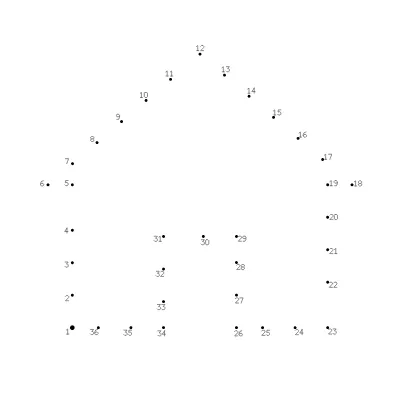
Dot-to-Dot
Connect the dots — parametric silhouettes with verified dot separation