Star Battle
Logic puzzlev1.0.0Star Battle — a star in every row, column and region, none touching.
Place a star in every row, every column and every region — no two stars touching, not even diagonally.
What it is
A square grid divided into as many regions as it has rows. The regions are the entire clue: there are no numbers anywhere. Exactly one star goes in each row, each column and each region, and stars never touch, even at a corner.
How to play
Start with the counting arguments: a region squeezed into one row means that row’s star is spoken for, so everything else in the row is empty. When a star lands, its eight neighbours are empty too — which often collapses a neighbouring region to a single candidate. Harder boards need placement reasoning: enumerate where a region’s star could go and keep only what every possibility agrees on.
Purpose
The most-requested modern logic genre the catalogue was missing — a staple of Puzzle Baron, GMPuzzles and championship sets. It also exercises a constraint shape the engine did not have: pure placement with an adjacency veto and no numeric clue at all, where the shape of the regions carries all the information.
History
Invented as Sternenschlacht by Hans Eendebak for the 2003 World Puzzle Championship, and popularised online as Star Battle. Published boards range from gentle 1★ 6×6s to the tournament-standard 2★ 10×10.
This implementation
- Spec knobs:
size(5–9; one star per line),difficulty,cell,line. - Generation: place a valid star arrangement first (depth-first, no two touching), grow one region around each star by seeded random flood, then accept only boards the shared solver proves unique.
- Solving: four propagators — line/region counting, exact placement enumeration (the no-touch rule folded in), star-neighbour elimination, and the genre’s signature confinement move (a region pinned to one line empties the rest of that line, and vice versa), rated at sudoku’s pointing-pair rung.
- Guarantees: deterministic per seed; exactly one solution, proven by
exhaustive count; solvable by the technique ladder without guessing, and
rated by the hardest technique actually used with board size as the
tie-break (
rating_basisnames this).
More logic puzzles
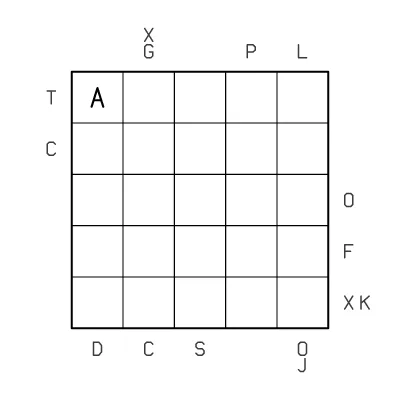
ABC Path
ABC Path — A to Y, each letter touching the next, guided by edge clues
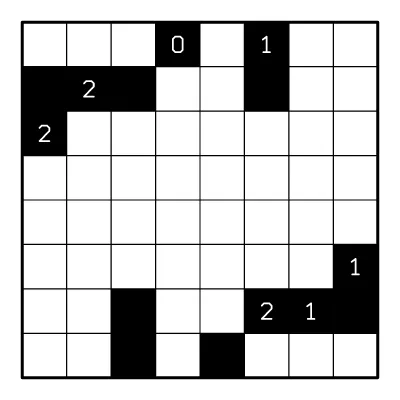
Akari (Light Up)
Place bulbs to light every cell, with no two bulbs shining on each other
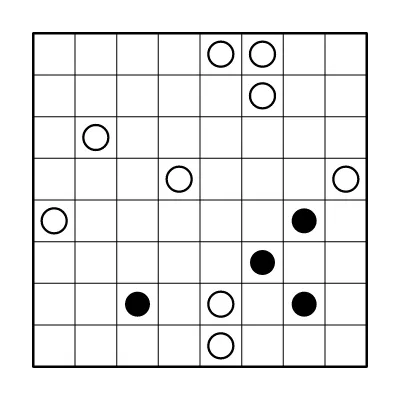
Binairo
Binairo — balance two symbols with no three alike and no twin lines
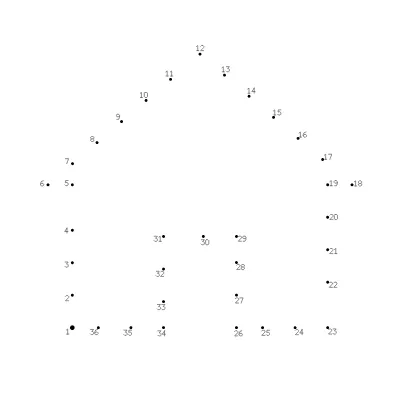
Dot-to-Dot
Connect the dots — parametric silhouettes with verified dot separation