String Art
Designv1.0.0String art — modular chord envelopes, cardioids and their kin.
Threads between pins on a circle: pin i connects to pin i·k mod n, and
the chords envelope a curve the thread never draws.
What it is
The multiplication table on a circle. k = 2 envelopes the cardioid, k = 3
the nephroid, and each higher multiplier adds a cusp; layered multipliers
(distinguished by line weight, the print-safe stand-in for thread colour)
build the familiar layered nail-and-thread look.
History
Curve stitching was invented by Mary Everest Boole in the late 19th century as a way to teach children the geometry of envelopes; the modular multiplication form became a mid-20th-century string-art and classroom staple, and the cardioid-in-a-mug connection keeps it alive in mathematical folklore.
The implementation’s guarantees
- The chord count is measured, not
pins × layers:i·k ≡ i (mod n)hasgcd(k−1, n)fixed points and those threads do not exist — a test pins the arithmetic (100 pins, k = 51: fifty chords, not ninety-eight). - Ink is the negotiation: the escalation ladder thins the thread to the 0.75 pt validator floor and then halves the chord density. Every stroke weight stays at or above the floor — the first version thinned past it and the validator said so.
- Rating basis: none — a design. Honesty fields: pins, multipliers, the drawn chord count, and the attempt the page settled at.
More designs
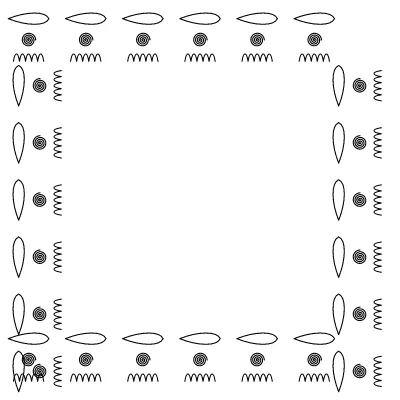
Border
Ornamental borders — the seven frieze groups over the motif library
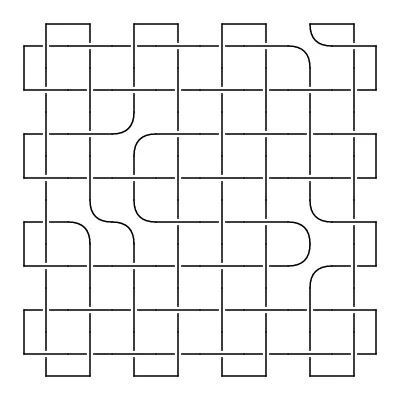
Celtic Plait
An interlaced plait: cords passing over and under, with cells that turn them back
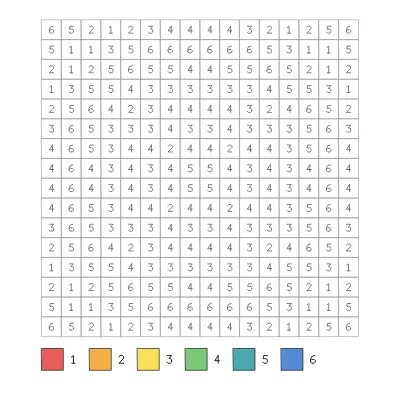
Colour by Number
Colour by number — a numbered grid that colours into a symmetric design
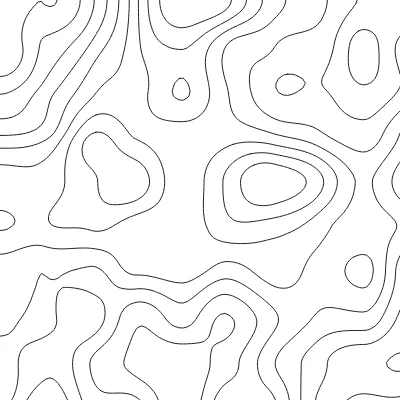
Contour
Contour lines — a seeded heightfield's level sets, terrain-map style