Suguru
Logic puzzlev1.0.0Suguru — each region counts itself, touching cells never match.
Each region holds the digits 1 up to its own size — and no two touching cells anywhere, diagonals included, may match.
What it is
A grid carved into irregular regions of up to five cells. A region of size k contains each digit 1..k exactly once, and identical digits never touch, not even at a corner. A handful of givens starts the chain.
How to play
Singletons and pairs place themselves. From there the touch rule does the work: a placed digit sweeps its eight neighbours clean, which often collapses a nearby region to one arrangement. Feel for the 2×2 blocks — four mutually touching cells always need four different digits, and that observation cracks most middle-game positions.
Purpose
A fast-growing newspaper genre (also sold as Tectonic) that slots straight
onto the shared solver: the region rule is AllDifferent unchanged, and the
touch rule is one elimination propagator. It also taught the workspace a
geometry lesson worth recording: a 2×2 block is a 4-clique under the touch
rule, so regions and digits cannot be generated separately — the carve has to
respect what the blocks can still drink from.
History
Invented by Naoki Inaba as Nanba burokku (number blocks); published across Europe as Suguru or Tectonic, where it has become a daily-paper staple.
This implementation
- Spec knobs:
size(5–9),difficulty,cell,line. - Generation: regions of three to five cells by seeded growth with boxed-in leftovers absorbed into neighbours; a Hall’s-condition check on every 2×2 block rejects uncolourable partitions before any search; the shared solver’s own search fills the survivors; digits are then dug out one at a time while the ladder still finishes the board at the requested ceiling.
- Guarantees: deterministic per seed; exactly one solution, proven by exhaustive count; solvable by inference alone; rated by the hardest technique the solve actually used.
More logic puzzles
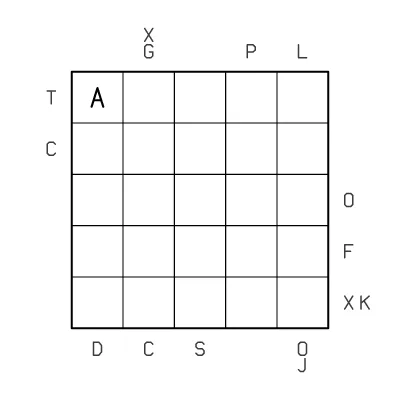
ABC Path
ABC Path — A to Y, each letter touching the next, guided by edge clues
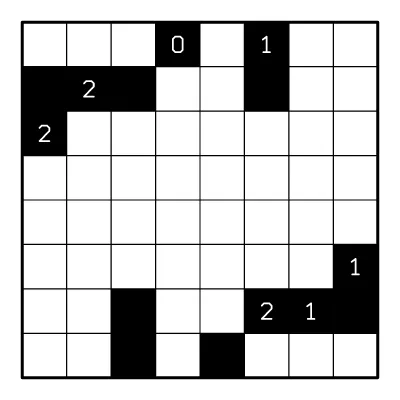
Akari (Light Up)
Place bulbs to light every cell, with no two bulbs shining on each other
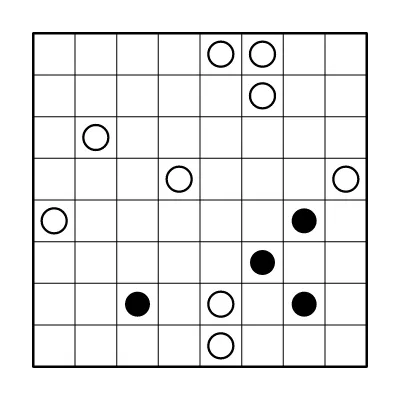
Binairo
Binairo — balance two symbols with no three alike and no twin lines
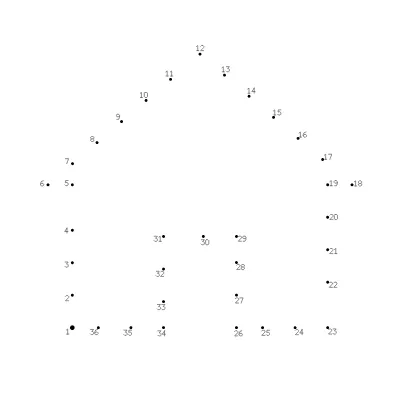
Dot-to-Dot
Connect the dots — parametric silhouettes with verified dot separation