Tiling
Designv1.0.0Islamic star, Truchet, Penrose and Cairo tilings as line art.
Islamic stars, Truchet fields, Penrose quasicrystals and Cairo pentagons — four families of tiling, one line-art generator.
What it is
Full-page geometric patterns from four traditions:
- Islamic star patterns by polygons-in-contact — the contact angle (30°–75°) changes the whole character of the design;
- Truchet tilings — a square tile with arcs, rotated per cell by a noise field, producing meandering connected curves;
- Penrose P2/P3 — aperiodic kite/dart and rhomb tilings by subdivision;
- Cairo pentagonal — the street-paving pentagon tiling.
How to use
Colouring pages: every family emits closed regions. Islamic stars reward symmetric palettes; Truchet fields read as mazes of ribbon to follow with a pen; Penrose pages never repeat, which colourists notice halfway through and either love or curse.
Purpose
The breadth crate of the design lane — four unrelated geometry traditions behind one spec, all validated by the same colourability gate. Each family is a different construction (contact geometry, noise-driven rotation, substitution rules, direct tiling), so the crate doubles as the workspace’s tiling toolbox.
History
Girih (Islamic strapwork) flourished from the 10th century across the Islamic world; its polygons-in-contact analysis is modern (Hankin, 1905). Sébastien Truchet, a Carmelite priest, catalogued his tile’s patterns in 1704. Roger Penrose published his aperiodic tilings in 1974 — later found echoed in medieval girih and in physical quasicrystals (Shechtman, Nobel 2011). The Cairo tiling paves streets of its namesake city.
This implementation
- Spec knobs:
pattern(family),size,repeats,stroke. - Generation: each family is its own constructor; Penrose by recursive subdivision, Truchet by a random rotation field, stars by polygons-in-contact with the angle parameter.
- What the seed drives: every family, not just Truchet — Islamic turns the stars (one global rotation plus a per-cell phase scheme), Penrose rotates and drifts the window into the aperiodic tiling, Cairo samples the pentagon family (0.366 is merely the equilateral member) and slides the lattice under the page. For a long time only Truchet consumed the RNG and the seed was dead for the other three; a test now pins all four.
- Guarantees: deterministic per seed; closed-region output validated by the colourability gate (region area, stroke width, ink coverage). Penrose depths 4+ exceed print resolution at default page size and fail the gate on every seed — measured, and recorded on the spec.
More designs
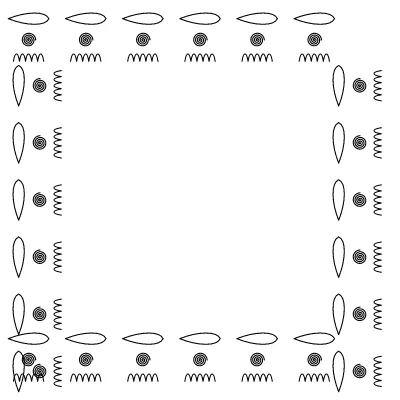
Border
Ornamental borders — the seven frieze groups over the motif library
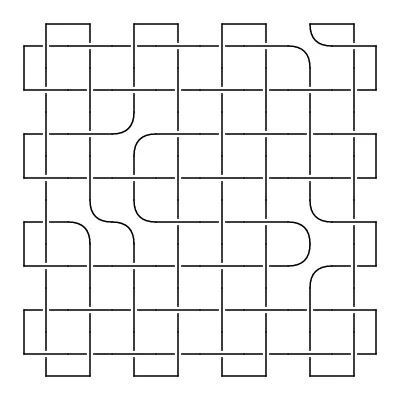
Celtic Plait
An interlaced plait: cords passing over and under, with cells that turn them back
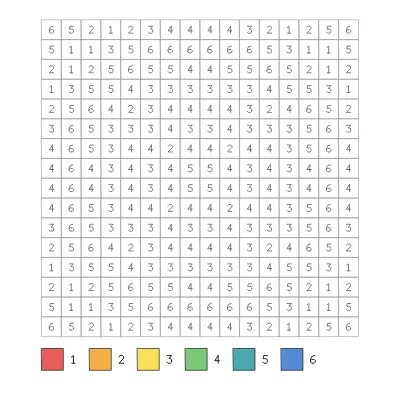
Colour by Number
Colour by number — a numbered grid that colours into a symmetric design
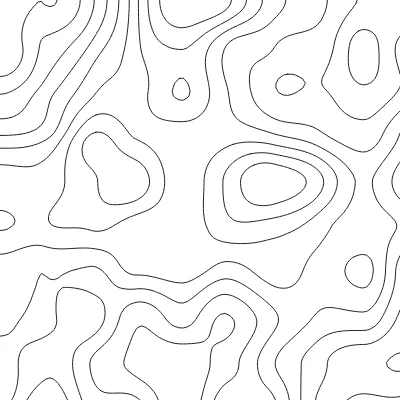
Contour
Contour lines — a seeded heightfield's level sets, terrain-map style